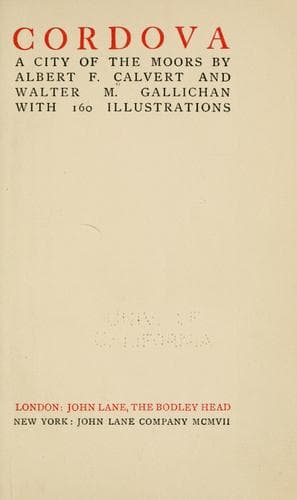
Cordova: A city of the MoorsCalvert, Albert Frederick
History
Cordova: A city of the Moors
Calvert, Albert Frederick
Arabs -- Spain; Córdoba (Spain) -- Description and travel; Córdoba (Spain) -- History
It is not a little singular that the present Cathedral of Cordova is
better known to the inhabitants of the city as _La Mezquita_, or Mosque,
than by its Christian designation; which circumstance may be taken as a
proof of the great influence exerted over Spanish thought and feeling by
the Moorish occupation of the Peninsula.
The truth is that Spanish and Moorish interests had much in common, and
both nations had equal pride in the celebration of notable deeds
performed by Mussulman or Christian. The mingling of the two peoples
after the conquest of Granada gave, at least to the commonalty of both
nations, a spirit of charity which it had been better to foster than to
extinguish.
This gentle sentiment is well expressed in a lament by Amados de los
Rios, a great Spanish antiquary and Orientalist, who sings a mournful
requiem over the departed glories of the Mosque, once the model of Arab
architecture, and the pride of Islam:--
‘Neither the sumptuous Christian fabric that to-day rises in the midst
of those countless columns, nor all the treasures of art lavished upon
it by the celebrated artists of the sixteenth century who erected it,
nor that interminable series of chapels of every epoch which, resting
against the walls of the Mosque, disfigure it; nor the clumsy angels
that seem to suspend their flight to shed glory over the divine service,
nor the words of the Evangelist sounding from the seat of the Holy
Spirit, can dispel or banish in the slightest degree the majesty of
those wandering shades, that in vain seek in the sanctuary the sacred
volume whose leaves, according to tradition, were enamelled with the
blood of the Khalif Othman, martyr to the faith. A world of souvenirs
here enthralls the mind of the traveller as he gazes with a feeling of
sorrow upon these profanations,--works dictated by the intolerant yet
sincere faith of our ancestors, impelled by the desire of banishing for
ever from that spot consecrated to the law of Jesus, the spirit of
Mohammed and the ghosts of his slaves that haunt it, and will for ever
haunt it while it exists. For, in spite of the mutilations it has
endured, and of the changes it has undergone, there is impressed upon
it, by a superior ineradicable law, the seal of the art that inspired
it, and the character of the people by whom it was planned and erected.’
Public-domain text, read in full here on John Shaqi.
Reviews
Reviews
No reviews yet
Be the first to share your thoughts on this work.
Join the Discussion
Join the discussion
Sign in to leave a comment or review.
Sign InorCreate an account