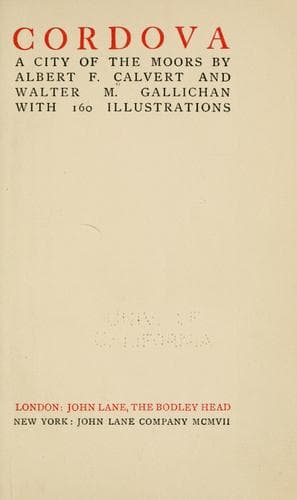
Cordova: A city of the MoorsCalvert, Albert Frederick
History
Cordova: A city of the Moors
Calvert, Albert Frederick
Arabs -- Spain; Córdoba (Spain) -- Description and travel; Córdoba (Spain) -- History
Don Amados is not alone in his eloquent, if unavailing protest. When
Charles V., in 1526, visited Cordova, and observed St. Peter’s (the
Coro) rising out of the very centre of the Mosque, he rebuked the
Bishop, Alonso Manriquez, who had erected the incongruous edifice, in no
measured terms. When the king saw the extent of the mischief, he said:
‘You have built here what you or any one might have built elsewhere; but
you have spoilt what was unique in the world.’ Alas! the monarch had
forgotten, or did not choose to remember, that the declaration came with
a very bad grace from one who, for his never-completed palace at
Granada, had torn down whole Courts and Halls of the Alhambra.
Like most Moorish buildings, the exterior of the Great Mosque of Cordova
has a somewhat forbidding aspect, and rises before one much unlike a
house of prayer.
The vast interior of the Mosque may be likened to a petrified grove of
palm-trees, their stems strangely varied in colour, and in amazing
perspective to all points of the compass. Marble columns of every hue,
from pure white and translucent alabaster, through the intervening red,
the precious verde antique, jasper, porphyry, all shades, to the deepest
black; the variety only to be explained by the fact that the great
builders Abd-er-Rahman I., together with his son and successor, Hisham
I., procured their materials whenever and wherever they could ‘acquire’
them. Many of the columns being too tall, were ‘topped’ to supply a
deficiency in the length of another--a process eloquent of the pillage
of many a distant city.[1]
All historians agree that the great Mosque of Cordova owes its inception
to Abd-er-Rahman I., the first sovereign to reign independently over
Andalus. Directly the Sultan found himself comparatively free from his
turbulent rivals, and firmly established on the throne, he began the
building of his royal palace--that of the pleasure-house called
Rissafah, and of the great Mosque. The circumstances which led to the
erection of the Mosque are thus related:--
When a city surrendered to the Moors by capitulation, it was their
custom to divide with the Christians the principal temple of that city.
So, for instance, when Damascus was taken, the principal temple was
divided, half of it remaining in the hands of the inhabitants for their
form of worship, while the other half was appropriated to the use of the
Moslems, who forthwith converted their moiety into a Mosque.
Public-domain text, read in full here on John Shaqi.
Reviews
Reviews
No reviews yet
Be the first to share your thoughts on this work.
Elsewhere in the archive
Join the Discussion
Join the discussion
Sign in to leave a comment or review.
Sign InorCreate an account