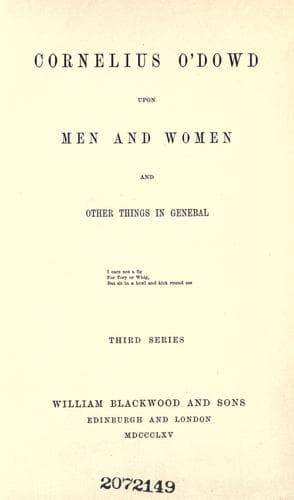
Cornelius O'Dowd Upon Men And Women And Other Things In GeneralLever, Charles
General
Cornelius O'Dowd Upon Men And Women And Other Things In General
Lever, Charles
Biography -- Humor; Essays; Italy -- Description and travel
Now, Mr B. C. who brought on this motion was a sorry artist, and the
whole sum and substance of his case was, that as we secured the services
of eminent and able men, we ought to pay them “properly.” Why, in that
one word “properly” lay the whole question. What constitutes proper
payment? Every career in life carries with it some circumstance either
of advantage or the reverse, which either compensates for the loss of a
material benefit, or is requited by some addition of a tangible profit.
The educated man who accepts three hundred a-year in the Church is
not recompensed, or considered to be recompensed, by this miserable
pittance. It is in the respect, the influence, the power, and the
reverence that attach to his calling he is rewarded. Place a layman in
the parish beside him with that income, and mark the difference of their
stations! The same of the soldier. Why or how does seven-and-sixpence
diurnally represent one the equal of the best in any society of the
land? Simply by a conventional treaty, by which we admit that a man,
at the loss of so much hard cash, may enjoy a station which bears no
imaginable proportion to his means.
On the other hand, there are large communities who, addressing
themselves to acquire wealth and riches, care very little for the
adventitious advantages of social state. As it is told of Theodore Hook,
at a Lord Mayor’s feast, that he laid down his knife and fork at the
fifth course, and declared “he would take the rest out in money;” so
there are scores of people who “go in” for the actual and the real. They
have no sympathy with those who “take out” their social status partly
in condition partly in cash, as is the case with the curate and the
captain.
Almost every man, at his outset in life, makes some computation of how
much his career can pay him in money, how much in the advantages of rank
and station. The bailiff on the estate makes very often a far better
income than the village doctor; but do you believe that Æsculapius would
change places with him for all that? Is not the unbought deference
to his opinion, the respect to his acquirements, the obedience to his
counsel, something in the contract he makes with the world? Does he
not recognise, every day of his life, that he is not measured by the
dimensions of the small house he resides in, or the humble qualities
of the hack he rides, but that he has an acceptance in society totally
removed from every question of his fortune?
Public-domain text, read in full here on John Shaqi.
Reviews
Reviews
No reviews yet
Be the first to share your thoughts on this work.
Elsewhere in the archive
Join the Discussion
Join the discussion
Sign in to leave a comment or review.
Sign InorCreate an account