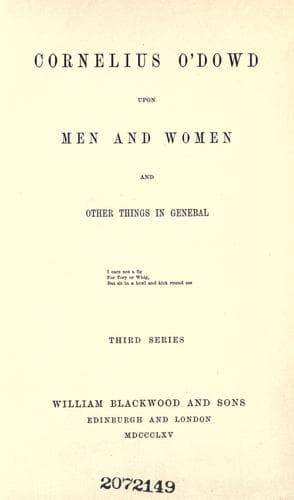
Cornelius O'Dowd Upon Men And Women And Other Things In GeneralLever, Charles
General
Cornelius O'Dowd Upon Men And Women And Other Things In General
Lever, Charles
Biography -- Humor; Essays; Italy -- Description and travel
I perceive that the writer of a letter to the ‘Times’ advocates the
claims of the ex-Governors, on the plausible plea that it is exactly the
very men who best represent the dignity of the station--best reflect the
splendour of the Sovereign--who come back poor and penniless from the
high office: while the penurious Governor, who has given dissatisfaction
everywhere, made the colony half rebellious by his narrow economies,
and degraded his station by contemptible savings, comes back wealthy and
affluent--self-pensioned, in fact, and independent.
To meet this end, the writer suggests that the Crown, as advised
thereon, should have a discretionary power of rewarding the well-doer
and refusing the claim of the unmeriting, which would distinctly
separate the case of the worthy servant of the Sovereign from that of
him who only employed his office to enrich himself.
There is a certain shallow--it is a very shallow--plausibility about
this that attracts at first sight; and there would unquestionably be
some force in it, if dinner-giving and hospitalities generally were the
first requisites of a colonial ruler; but I cannot admit this. I cannot
believe that the man who administers India or Canada, or even Jamaica
or Barbadoes, is only an expatriated Lord Mayor. I will not willingly
consent to accept it as qualification for a high trust that a man has
a good cook and an admirable cellar, and an ostentatious tendency to
display the merits of both. Mind, I am no ascetic who say this: I like
good dinners; I like occasionally--only occasionally though--very good
dinners. I feel with a clever countryman who said he liked being asked
out to dine, “it was flattering, and it was nourishing;” but with all
this I should never think of “elevating my host” to the dignity of high
statesmanship on the mere plea of his hospitality.
We have had some able men in our dependencies who were not in the least
given to social enjoyments, who neither understood them for themselves
nor thought of them for others--Sir Charles Napier, for instance. And
who, let me ask, would have lost the services of such a man to the
State, because he had not the tastes of a Sir William Curtis, nor could
add a “Cubitt” to his stature?
All discretionary powers are, besides, abuses. They are the snares and
pitfalls of official jobbery; and there would be no end of bickering and
complaining on the merits of this and the shortcomings of that man.
Not to say that such a system as this writer recommends would place a
Government in the false position of rewarding extravagance and offering
a premium for profusion, and holding up for an example to our colonial
fellow-subjects the very habits and tastes which are the bane and
destruction of young communities.
Public-domain text, read in full here on John Shaqi.
Reviews
Reviews
No reviews yet
Be the first to share your thoughts on this work.
Elsewhere in the archive
Join the Discussion
Join the discussion
Sign in to leave a comment or review.
Sign InorCreate an account