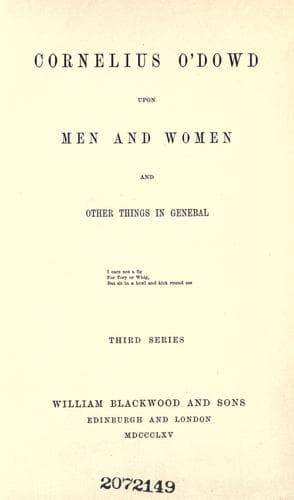
Cornelius O'Dowd Upon Men And Women And Other Things In GeneralLever, Charles
General
Cornelius O'Dowd Upon Men And Women And Other Things In General
Lever, Charles
Biography -- Humor; Essays; Italy -- Description and travel
Indifferentism is the tone of the day. No one must be eager, pleased,
displeased, interested, or anxious about anything. Life is to be treated
as a tiresome sort of thing, but which is far too much beneath one to
be thought of seriously--a wearisome performance, which good manners
require you should sit out, though nothing obliges you to applaud or
even approve of it. This is the theory, and we have been most successful
in reducing it to practice. We are immensely bored, and we take good
care so shall be our neighbour. Just as we have voted that there is
nothing new, nothing strange, nothing amusing, we defy any one to differ
with us, on pain of pronouncing him vulgar. North American Indians are
not more case-hardened against any show of suffering under torture than
are our well-bred people against any manifestation of showing pleasure
in anything. “It wasn’t bad,” is about the highest expression of our
praise; and I doubt if we would accord more to heaven--if we got there.
The grand test of your modern Englishman is, to bear any amount of
amusement without wincing: no pleasure is to wring a smile from him, nor
is any expectancy to interest, or any unlooked-for event to astonish. He
would admit that “the Governor”--meaning his father--was surprised; he
would concede the fact, as recording some prejudice of a bygone age. As
the tone of manners and observance has grown universal, so has the very
expression of the features. They are intensely like each other. We are
told that a shepherd will know the actual faces of all the sheep in his
flock, distinguishing each from each at a glance. I am curious to know
if the Bishop of London knows even the few lost sheep that browse about
Rotten Eow of an afternoon, and who are so familiar to us in Leech’s
sketches. There they are--whiskered, bearded, and bored; fine-looking
animals in their way, but just as much living creatures in ‘Punch’
as they are yonder. It is said that they only want the stimulus of a
necessity, something of daring to tempt, or something of difficulty to
provoke them, to be just as bold and energetic as ever their fathers
were. I don’t deny it. I am only complaining of the system which makes
sheep of them, reduces life to a dreary table-land, making the stupid
fellows the standard, and coming down to their level for the sake of
uniformity. Formerly they who had more wit, more smartness, more worldly
knowledge than their neighbours, enjoyed a certain pre-eminence; the
flash of their agreeability lighted up the group they talked in, and
they were valued and sought after. Now the very homage rendered, even in
this small way, was at least a testimony that superiority was recognised
and its claims admitted. What is the case now? Apathy is excellence,
and the nearest approach to insensibility is the greatest eminence
attainable.
Public-domain text, read in full here on John Shaqi.
Reviews
Reviews
No reviews yet
Be the first to share your thoughts on this work.
Elsewhere in the archive
Join the Discussion
Join the discussion
Sign in to leave a comment or review.
Sign InorCreate an account