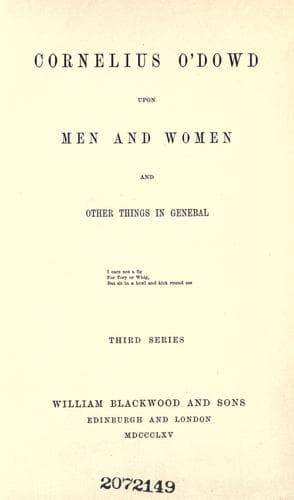
Cornelius O'Dowd Upon Men And Women And Other Things In GeneralLever, Charles
General
Cornelius O'Dowd Upon Men And Women And Other Things In General
Lever, Charles
Biography -- Humor; Essays; Italy -- Description and travel
I am well aware that it sounds something little short of a heresy to
make this declaration. It is enough to make the blood of Civil-Service
Commissioners run cold to hear it. It sounds illiberal--and, worse,
it seems illogical. Why should any intellectual development imply
deficiency? Why should an acquirement argue a defect? I answer, I don’t
know--any more than I know why sanguineous people are hot-tempered, and
leuco-phlegmatic ones are more brooding in their wrath. If--for I do not
ask to be anything higher than empirical--if I find that parsimonious
people have generally thin noses, and that the snub is associated with
the spendthrift, I never trouble myself with the demonstration, but I
hug the fact, and endeavour to apply it.
In the same spirit, if I hear a man in a salon change from French to
German and thence diverge into Italian and Spanish, with possibly a
brief excursion into something Scandinavian or Sclav--at home in each
and all--I would no more think of associating him in my mind with
anything responsible in station or commanding in intellect, than I
should think of connecting the servant that announced me with the last
brilliant paper in the ‘Quarterly.’
No man with a strongly-marked identity--and no really able man ever
existed without such--can subordinate that identity so far as to put on
the foreigner; and without this he never can attain that mastery of
a foreign language that makes the linguist. To be able to repeat
conventionalities--bringing them in at the telling moment, adjusting
phrases to emergencies, as a joiner adapts the pieces of wood to his
carpentry--may be, and is, a very neat and a very dexterous performance,
but it is scarcely the exercise to which a large capacity will address
itself. Imitation must be, in one sense or other, the stronghold of the
linguist--imitation of expression, of style, of accent, of cadence, of
tone. The linguist must not merely master grammar, but he must manage
gutturals. The mimicry must go farther: in simulating expression it must
affect the sentiment. You are not merely borrowing the clothes, but you
are pretending to put on the feelings, the thoughts, the prejudices
of the wearer. Now, what man with a strong nature can merge himself so
entirely in his fictitious being as not to burst the seams and tear the
lining of a garment that only impedes the free action of his limbs, and
actually threatens the very extinction of his respiration?
Public-domain text, read in full here on John Shaqi.
Reviews
Reviews
No reviews yet
Be the first to share your thoughts on this work.
Elsewhere in the archive
Join the Discussion
Join the discussion
Sign in to leave a comment or review.
Sign InorCreate an account