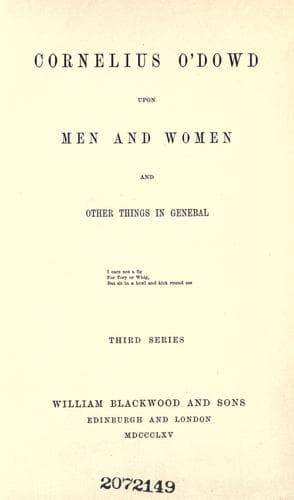
Cornelius O'Dowd Upon Men And Women And Other Things In GeneralLever, Charles
General
Cornelius O'Dowd Upon Men And Women And Other Things In General
Lever, Charles
Biography -- Humor; Essays; Italy -- Description and travel
Many people would scruple to play at cards with a stranger whose mode of
dealing and general manipulation of the pack bespoke daily familiarity
with the play-table. They would infer that he was a regular and
professional gambler. In the very same way, and for the selfsame reason,
would I carefully avoid any close intimacy with the Englishman of fluent
French, well knowing he could not have graduated in that perfection save
at a certain price. But it is not at the moral aspect of the question I
desire particularly to look. I assert--and I repeat my assertion--that
these talkers of many tongues are poor creatures. There is no initiative
in them--they suggest nothing--they are vendors of second-hand wares,
and are not always even good selectors of what they sell. It is only
in narrative that they are at all endurable. They can _raconter_,
certainly; and so long as they go from salon to salon repeating in
set phrase some little misadventure or accident of the day, they are
amusing; but this is not conversation, and they do not converse.
“Every time a man acquires a new language, is he a new man?” is supposed
to have been a saying of Charles V.--a sentiment that, if he uttered it,
means more of sarcasm than of praise; for it is the very putting off
a man’s identity that establishes his weakness. All real force of
character excludes dualism. Every eminent, every able man has a certain
integrity in his nature that rejects this plasticity.
It is a very common habit, particularly with newspaper writers, to
ascribe skill in languages, and occasionally in games, to distinguished
people. It was but the other day we were told that Garibaldi spoke ten
languages fluently. Now Garibaldi is not really master of two. He
speaks French tolerably; and his native language is not Italian, but
a patois-Genoese. Cavour was called a linguist with almost as little
truth; but people repeat the story, just as they repeat that Napoleon I.
was a great chess-player. If his statecraft and his strategy had been on
a par with his chess, we should never have heard of Tilsit or Wagram.
Public-domain text, read in full here on John Shaqi.
Reviews
Reviews
No reviews yet
Be the first to share your thoughts on this work.
Elsewhere in the archive
Join the Discussion
Join the discussion
Sign in to leave a comment or review.
Sign InorCreate an account