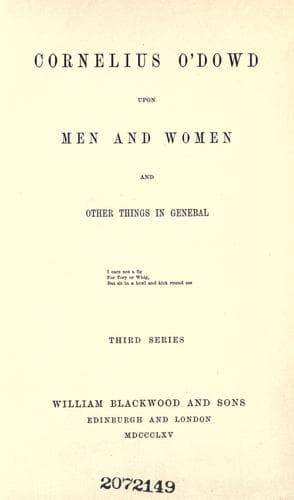
Cornelius O'Dowd Upon Men And Women And Other Things In GeneralLever, Charles
General
Cornelius O'Dowd Upon Men And Women And Other Things In General
Lever, Charles
Biography -- Humor; Essays; Italy -- Description and travel
The Decalogue declares: “Thou shalt not commit a murder.” Human law
pronounces what will come of it if you do. It is, doubtless, very
imperfect legislation, but there is no help for it. We accept such
cases, however, as the best defences we can find for our social
condition, never for a moment presuming to think that we are rendering a
vice impossible by attaching to it a penalty.
Mr Lawson, however, says, There shall be no drunkenness, because there
shall be no liquor. Why not extend the principle--for it is a great
discovery--and declare that, wherever four-fifths of the ratepayers of
a town or borough are of opinion that ingratitude is a great offence to
morals and a stain to human nature, in that district where they reside
there shall be no benefits conferred, nor any act of kindly aid or
assistance rendered by one man to his neighbour? I have no doubt that,
by such legislation, you would put down ingratitude. We use acts in the
moral world pretty much as in the physical; and it is entirely by the
impossibility of committing the offence that this gentleman proposes
to prevent its occurrence. But, in the name of common sense, why do we
inveigh against monasteries and nunneries?--why are we so severe on a
system that substitutes restraint for reason, and instead of correction
supplies coercion? Surely this plan is based on exactly the same
principle. Would it, I ask, cure a man of lying--I mean the vice, not
the practice--to place him in a community where no party was permitted
to talk?
The example of the higher classes was somewhat ostentatiously paraded in
the debate, and members vied with each other in declaring how often
they dined out without meeting a drunkard in the company. This is very
gratifying and reassurring; but I am not aware that anybody ascribed
the happy change to the paucity of the decanters, and the difficulty of
getting the bottle; or whether it was that four-fifths of the party
had declared an embargo on the sherry, and realised the old proverb by
elevating necessity to the rank of virtue.
Let me ask, who ever imagined that the best way to render a soldier
brave in battle was to take care that he never saw an enemy, and only
frequented the society of Quakers? And yet this is precisely what
Mr Lawson suggests. If his system be true, what becomes of all moral
discipline and all self-restraint? It is not through my own convictions
that I am sober; it is through no sense of the degradation that pertains
to drunkenness, and the loss of social estimation that follows it, that
I am temperate. It is because four-fifths of the ratepayers declare that
I shall have no drink nearer than the next parish; and this reminds of
another weak point in the plan.
Public-domain text, read in full here on John Shaqi.
Reviews
Reviews
No reviews yet
Be the first to share your thoughts on this work.
Elsewhere in the archive
Join the Discussion
Join the discussion
Sign in to leave a comment or review.
Sign InorCreate an account