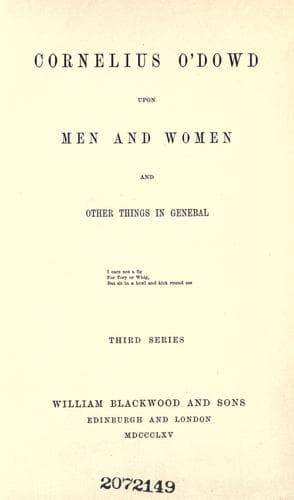
Cornelius O'Dowd Upon Men And Women And Other Things In GeneralLever, Charles
General
Cornelius O'Dowd Upon Men And Women And Other Things In General
Lever, Charles
Biography -- Humor; Essays; Italy -- Description and travel
Such a man may be misled; he can never be corrupted.
A NEW INVESTMENT.
I am not so sure how far we ought to be grateful for it, but assuredly
the fact is so, that nothing has so much tended to show the world with
what little wisdom it is governed than the Telegraph. It is not merely
that cabinets are no longer the sole possessors of early intelligence,
though this alone was once a very great privilege; and there is no
over-estimating the power conferred by the exclusive possession of
a piece of important news--a battle won or lost, the outbreak of a
revolution, the overthrow of a throne--even for a few hours before it
became the property of the public. The telegraph, however, is the great
disenchanter. The misty uncertainty, the cloud-like indistinctness that
used of old to envelop all ministerial action, converting Downing
Street into a sort of Olympus, and making a small mythology out of
Precis-writers, is all gone, all dispersed. Three or four cold hard
lines, thin and terse as the wire that conveyed them, are sworn enemies
to all style, and especially to all the evasive cajoleries of those
dissolving views of events diplomacy loves to revel in. What becomes of
the graceful drapery in which statesmen used to clothe the great facts
of the world, when a simple despatch, “fifteen words, exclusive of
the address,” tells the whole story? and when we have read that “the
insurgents are triumphant everywhere, the king left the capital at four
o’clock, a provisional government was proclaimed this morning,” and
suchlike, what do we care for the sonorous periods in which official
priestcraft chants the downfall of a dynasty?
The great stronghold of statecraft was, however, Speculation--I mean
that half-prophetic view of events which we always conceded to those
who looked over the world from a higher window than ourselves. What
has become of this now? Who so bold as to predict what, while he is yet
speaking, may be contradicted? who is there hardy enough to forecast
what the events of the last half-hour may have falsified, and five
minutes more will serve to publish to the whole world?
It may be amusing to read the comments of the speech or the leading
article, but the “despatch” is the substance: and however clever the
variations, the original melody remains unaltered. Let any one imagine
to himself a five-act drama, preceded by a telegraphic intimation of
all its incidents--how insupportable would the slow procession of events
become after such a revelation! Up to this, Ministers performed a sort
of Greek chorus, chanting in ambiguous phrase the woes that invaded
those who differed from them, and the heart-corroding sorrows that sat
below the “gangway.” There has come an end to all this. All the dramatic
devices of those days are gone, and we live in an age in which many
men are their own priests, their lawyers, and their doctors, and where,
certes, each man is his own prophet.
Public-domain text, read in full here on John Shaqi.
Reviews
Reviews
No reviews yet
Be the first to share your thoughts on this work.
Elsewhere in the archive
Join the Discussion
Join the discussion
Sign in to leave a comment or review.
Sign InorCreate an account