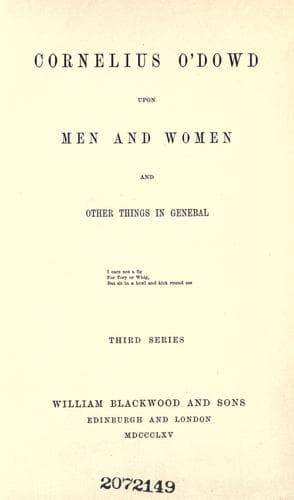
Cornelius O'Dowd Upon Men And Women And Other Things In GeneralLever, Charles
General
Cornelius O'Dowd Upon Men And Women And Other Things In General
Lever, Charles
Biography -- Humor; Essays; Italy -- Description and travel
“Will Jones, think you, presume to be imperative if it be Alfred
Tennyson who has brought up his hot water? Will Brown be critical about
the polish, if it be Owen Meredith has taken him his boots? Will even
Snooks cry out, ‘Holloa, you fellow!’ to a passing waiter, if the
individual so addressed might chance to be an Oriental Secretary or a
Saturday Reviewer?
“And would the most infatuated of Bagmen venture on what O’Connell used
to call a ‘chuck-under-the-chin manner,’ were the chamber-maid to be
Margaret Maitland?
“Such, in brief, is my plan, O’Dowd; nor is the least of its advantages
that it gets rid of the Pension List, and that beggarly £1200 a-year by
which wealthy England assumes to aid the destitute sons and daughters
of letters. As for myself, I have fixed on my station. I mean to be
swimming-master, and the prospectus shall announce that His Excellency
the late Minister at the Court of-----ducks ladies every morning from
eight till nine. Think over the project, and drop me a hint as to the
sort of place would suit you.”
ITALIAN TRAITS AND CHARACTERISTICS.
My diplomatic friend is rarely very serious in his humour; this morning,
however, he was rather disposed that way, and so I took the opportunity
to question him about Italy, a country where he has lived long, and
whose people he certainly understands better than most Englishmen. I
gathered from him that he considered the English were thoroughly
well informed on Italy, but in the most hopeless ignorance as to the
Italians. “As for the house and the furniture, you know it all.” said
he; “but of the company you know positively nothing.”
Byron understood them better than any other Englishman. He had his
admission _par la petite porte_--that is, he gained his knowledge
through his vices; and the Italians were so flattered to see a great
Milor adapt himself so readily to their lax notions and loose morality
that they grew frank and open with him.
His pretended--I suppose it was only pretended--dislike to England
disarmed them, too, of all distrust of him; and for the first time they
felt themselves judged by a man who did not think Charing Cross finer
than the Piazza del Popolo.
Byron’s rank and station gained him a ready acceptance where the masses
of our travelling countrymen would not be received; for the Italians
love rank, and respect all its gradations. Even the republics were great
aristocracies; and in all their imitations of France they have never
affected “equality.” They love splendour too, and display; and in all
their festivals you see something like an effort to recall a time when
their cities were the grandest and their citizens the proudest in all
Europe.
They are a very difficult people to understand. There are not so many
salient points in the Italian as in the German or the Frenchman; his
character is not so strongly accented; his traits are finer--his shades
of temperament more delicate.
Public-domain text, read in full here on John Shaqi.
Reviews
Reviews
No reviews yet
Be the first to share your thoughts on this work.
Elsewhere in the archive
Join the Discussion
Join the discussion
Sign in to leave a comment or review.
Sign InorCreate an account