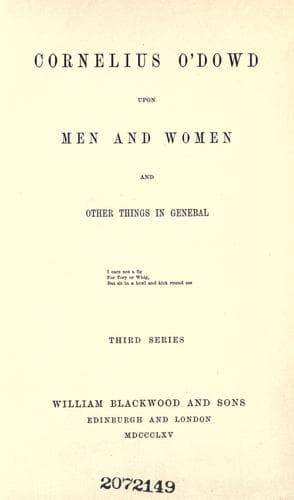
Cornelius O'Dowd Upon Men And Women And Other Things In GeneralLever, Charles
General
Cornelius O'Dowd Upon Men And Women And Other Things In General
Lever, Charles
Biography -- Humor; Essays; Italy -- Description and travel
Of all the nations of Europe, I know of none, save Italy, in which the
characters are the same in every class and gradation. The appeal you
would make to the Italian noble must be the same you would address to
the humble peasant on his property. The point of view is invariably
identical; the sympathies are always alike. No matter what differences
education may have instituted and habits implanted, the nobleman and his
lackey think and feel and reason alike. Separate them how you will in
station, and they will still approach the consideration of any subject
in the same spirit, and regard it with the same hopes and fears, the
same expectations and distrusts. To this trait, of whose existence
Cavour well knew, was owing the marvellous unanimity in the nation on
the last war with Austria. The appeal to the prince could be addressed,
and was addressed, to the peasant. There was not an argument that spoke
to the one which was not re-echoed in the heart of the other. In fact,
the chain that binds the social condition of Italy is shorter than
elsewhere, and the extreme links are less remote from each other than
with most nations of Europe.
Every Italian is a conspirator, whether the question be the gravest
or the lightest; all must be done in it ambiguously--secretly--
mysteriously. Whatever is conducted openly is deemed to be done
stupidly. To take a house, buy a horse, or hire a servant without the
intervention of another man to disparage the article, chaffer over the
price, and disgust the vendor, is an act of impetuous folly. “Why didn’t
you tell _me!_” says your friend, “that you wished to have that villa?
My coachman is half-brother to the wife of the _fattore_. I could have
learned everything that could be urged against its convenience, and
learned, besides, what peculiar pressure for money affected the owner.”
Besides this, everything must be done as though by mere hazard: you
really never knew there was a house there, never noticed it; you even
sneer at the taste of the man who selected the spot, and wonder “what he
meant by it.” In nine cases out of ten the other party is not deceived
by this skirmishing; he fires a little blank-cartridge too, and so goes
on the engagement. All have great patience; life, at least in Italy, is
quite long enough for all this; no one is overburdened with business;
the days are usually wearisome, and the theatres are only open of an
evening!
It is, besides, so pleasant and so interesting to the Italian to pit
his craft against another man’s, and back his own subtlety against his
neighbour’s. It is a sort of gambling of which he never wearies; for
the game is one that demands not merely tact, address, and cunning,
but face, voice, manner, and bearing. It is temperament. Individuality
itself is on the table; and so is it, that you may assume it as certain
that the higher organisation will invariably rise the winner.
Public-domain text, read in full here on John Shaqi.
Reviews
Reviews
No reviews yet
Be the first to share your thoughts on this work.
Elsewhere in the archive
Join the Discussion
Join the discussion
Sign in to leave a comment or review.
Sign InorCreate an account