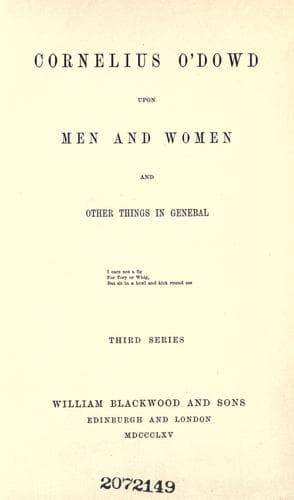
Cornelius O'Dowd Upon Men And Women And Other Things In GeneralLever, Charles
General
Cornelius O'Dowd Upon Men And Women And Other Things In General
Lever, Charles
Biography -- Humor; Essays; Italy -- Description and travel
Now, if the conversational tone of our time were pre-eminently
brilliant--if people were wiser, wittier, more amusing, and more
instructive than formerly--if we lived in an age of really good
talkers,--I might assent to the force of this explanation; but what is
the truth? Ours is, of all the times recorded by history, the dullest
and dreariest: rare as whist-players are, pleasant people are still
rarer. It is not merely that the power of entertaining is gone, but so
has the ambition. Nobody tries to please, and the success is admirable!
It is fashionable to be stupid, and we are the most modish people in the
universe. It is absurd, then, in a society whose interchange of thought
is expressed in monosyllables, and a certain haw-haw dreariness pervades
all intercourse, to say that people are above Whist. Why, they are below
Push-pin!
It would be sufficient to point to the age when Whist was most in vogue,
to show that it flavoured a society second to none in agreeability; and
who were the players? The most eminent divines, the greatest ministers,
the most profound jurists, the most subtle diplomatists. What an
influence a game so abounding in intellectual teaching must have
exercised on the society where it prevailed, can scarcely be computed.
Blackstone has a very remarkable passage on the great social effect
produced upon the Romans by their popular games; and he goes so far as
to say that society imbibes a vast amount of those conventionalities
which form its laws, from an Tin-conscious imitation of the rules which
govern its pastimes. Take our own time, and I ask with confidence,
should we find such want of purpose as our public men exhibit, such
uncertainty, such feebleness, and such defective allegiance to party,
in a whist-playing age? Would men be so ready as we see them to renounce
their principles, if they bore fresh in their mind all the obloquy that
follows “a revoke”? Would they misquote their statistics in face of the
shame that attends on “a false score”? Would they be so ready to assert
what they know they must retract, if they had a recent recollection of
being called on “to take down the honours”?
Think, then, of the varied lessons--moral as well as mental--that the
game instils; the caution, the reserve, the patient attention, the
memory, the deep calculation of probabilities, embracing all the rules
of evidence, the calm self-reliance, and the vigorous daring that shows
when what seems even rashness may be the safest of all expedients.
Imagine the daily practice of these gifts and faculties, and tell me,
if you can, that he who exercises them can cease to employ them in his
everyday life. You might as well assert that the practice of gymnastics
neither develops the muscle nor increases strength.
Public-domain text, read in full here on John Shaqi.
Reviews
Reviews
No reviews yet
Be the first to share your thoughts on this work.
Elsewhere in the archive
Join the Discussion
Join the discussion
Sign in to leave a comment or review.
Sign InorCreate an account