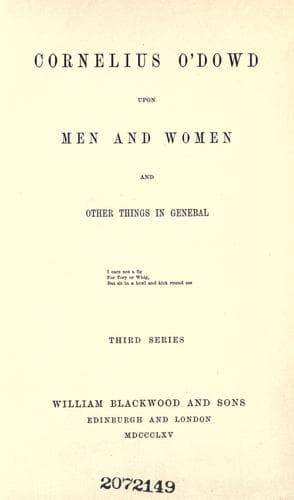
Cornelius O'Dowd Upon Men And Women And Other Things In GeneralLever, Charles
General
Cornelius O'Dowd Upon Men And Women And Other Things In General
Lever, Charles
Biography -- Humor; Essays; Italy -- Description and travel
It would be easy for me to illustrate the inestimable benefits of this
situation, if we possessed what, to the scandal of our age, we do
not possess--any statistics of Whist. Newspapers record the oldest
inhabitant or the biggest gooseberry, but tell us nothing biographical
of those who have illustrated the resources and extended the boundaries
of this glorious game. We even look in vain for any mention of Whist in
the lives of some of its first proficients. Take Cavour, for instance.
Not one of his biographers has recorded his passion for Whist, and yet
he was a good player: too venturous, perhaps--too dashing--but splendid
with “a strong hand!” During all the sittings of the Paris Congress he
played every night at the Jockey Club, and won very largely--some say
above twenty thousand pounds.
The late Prince Metternich played well, but not brilliantly. It was a
patient, cautious, back-game, and never fully developed till the last
card was played. He grew easily tired too, and very seldom could sit
out more than twelve or fourteen rubbers; unlike Talleyrand, who always
arose from table, after perhaps twelve hours’ play, fresher and brighter
than when he began. Lord Melbourne played well, but had moments of
distraction, when he suffered the smaller interests of politics to
interfere with his combinations. I single him out, however, as a
graceful compliment to a party who have numbered few good players in
their ranks; for certainly the Tories could quote folly ten to
one whisters against the Whigs. The Whigs are too superficial, too
crotchety, and too self-opinionated to be whist-players; and, worse than
all, too distrustful. A Whig could never trust his partner--he could not
for a moment disabuse himself of the notion that his colleague meant to
outwit him. A Whig, too, would invariably try to win by something
not perfectly legitimate; and, last of all, he would be incessantly
appealing to the bystanders, and asking if he had not, even if
egregiously beaten, played better than his opponents.
The late Cabinet of Lord Derby contained some good players. Two of the
Secretaries of State were actually fine players, and one of them adds
Whist to accomplishments which would have made their possessor an
Admirable Crichton, if genius had not elevated him into a far loftier
category than Crichtons belong to. Rechberg plays well, and likes
his game; but he is in Whist, as are all Germans, a thorough pedant. I
remember an incident of his whist-life sufficiently amusing in its way,
though, in relation, the reader loses what to myself is certainly the
whole pungency of the story: I mean the character and nature of the
person who imparted the anecdote to me, and who is about the most
perfect specimen of that self-possession, which we call coolness, the
age we live in can boast of.
Public-domain text, read in full here on John Shaqi.
Reviews
Reviews
No reviews yet
Be the first to share your thoughts on this work.
Elsewhere in the archive
Join the Discussion
Join the discussion
Sign in to leave a comment or review.
Sign InorCreate an account