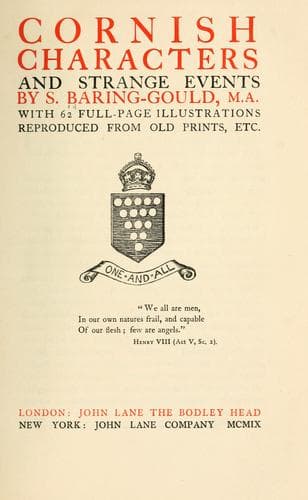
Cornish Characters and Strange EventsBaring-Gould, S. (Sabine)
History
Cornish Characters and Strange Events
Baring-Gould, S. (Sabine)
Cornwall (England : County) -- Biography; Cornwall (England : County) -- History; Legends -- England -- Cornwall (County)
Madras, at the mouth of the Triplicane, consisted of the native or
black city and of Fort S. George, which lay on the sea, and was almost
engirdled by the North River that with the Triplicane formed an
island crossed by the main road from Chinglapett and Vandalone.
The French, whilst in possession of Fort S. George, after it had been
taken by Labourdonnais in 1746, had made several improvements and
additions to the slight works they found, which, nevertheless, rendered
the fort little capable of long resistance against the regular
approaches of a European enemy; nor had they given any attention to the
internal area, which did not exceed fifteen acres of ground.
Nevertheless, the English let the place remain in the same state after
its recovery from the French in 1751 till the beginning of the year
1756, when the expectation of another war with that nation, and the
reports of the great preparations making in France against India,
dictated the necessity of rendering it completely defensible; and Call
was employed in the extension and perfecting of the work, that had
received the consideration of Robbins before his decease. Accordingly
all the coolies, labourers, and tank diggers whom the adjacent country
could supply were from this time constantly employed on the
fortifications: their daily number generally amounted to four thousand
men, women, and children. The river channel was diverted, and the old
channel was filled up; very extensive bastions and outworks were
erected; and it was due to this undertaking that Fort S. George was able
to stand successfully against the siege by the Count de Lally in 1759.
In the beginning of the year 1752 Call accompanied Captain (afterwards
Lord) Clive in an expedition against the French, who had possessed
themselves of the province of Arcot, and were plundering up to the
very gates of Madras; and he was with him in his occupation and
subsequent defence of Arcot, during a fifty days' siege. Clive had
marched from Madras with two hundred English soldiers and three
hundred sepoys. He had with him eight English officers, but of these
only two had smelt powder, whilst four, Call among them, were only
commercial clerks forced by Clive's example to draw the sword. The
battle of Coverplank, near Arcot, gained by Captain Clive in the
February of 1752, in which the French lost all their artillery and
were totally dispersed, cleared the province of their influence and
established the English in the garrison of that capital. From Arcot
the victorious army, consisting of about five hundred Europeans and
one thousand natives, marched through the country back to Fort S.
David, when Mr. Call was appointed chief engineer at Madras, and
eventually of all the Coromandel coast.
Public-domain text, read in full here on John Shaqi.
Reviews
Reviews
No reviews yet
Be the first to share your thoughts on this work.
Elsewhere in the archive
Join the Discussion
Join the discussion
Sign in to leave a comment or review.
Sign InorCreate an account