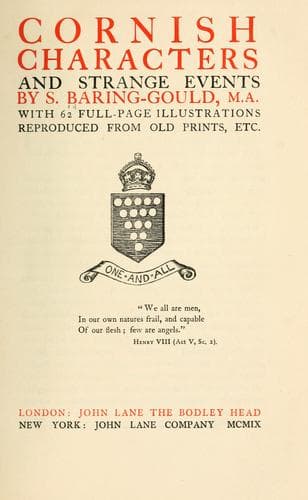
Cornish Characters and Strange EventsBaring-Gould, S. (Sabine)
History
Cornish Characters and Strange Events
Baring-Gould, S. (Sabine)
Cornwall (England : County) -- Biography; Cornwall (England : County) -- History; Legends -- England -- Cornwall (County)
At the age of twenty-one he was taken into the establishment at Stowe.
He then measured seven feet two inches in height without his shoes,
and he afterwards grew two inches higher. He was not tall and lanky,
but stout and well proportioned in every way. The original mansion of
the Grenvilles at Stowe still in part remains as a farmhouse. The
splendid house of Stowe, built by the first Earl of Bath, was pulled
down shortly after 1711, and it was said that men lived who had seen
the stately palace raised and also levelled with the dust. This was at
a little distance further inland than the old Stowe that remains. The
Grenvilles had also a picturesque house at Broom Hill, near Bude, with
fine Elizabethan plaster-work ceilings, now converted into labourers'
cottages.
At Stowe Anthony Payne delighted in exhibiting his strength. In the
hurling-ground a rough block of stone is still pointed out as "Payne's
cast," lying full ten paces beyond the reach whereat the ordinary
player could "put the stone."
It is said that one Christmas Eve the fire languished in the hall. A
boy with an ass had been sent into the wood for faggots. Payne went to
hurry him back, and caught up the ass and his burden, flung them over
his shoulder, and brought both into the hall and cast them down by the
side of the fire.
On another occasion, being defied to perform the feat, he carried a
bacon-hog from Kilkhampton to Stowe. Then came the Civil War, when
Charles I and his Parliament sought to settle their differences on the
battlefield. Cornwall went for the King, and Anthony Payne had the
drilling and manœuvring of the recruits from Kilkhampton and Stratton.
At one time Sir Beville Grenville had his head-quarters at Truro, but
the great battle of Stamford Hill, May 16th, 1643, was fought but eight
miles from Stowe, and on the night preceding it Sir Beville Grenville
slept in his house at Broom Hill. The battle was desperate, the Royalist
soldiers being outnumbered, and attacked; amidst them was Anthony Payne,
mounted on his sturdy cob Samson, rallying his troopers and terrorizing
the enemy, who fled. At the next pitched battle at Lansdown, near
Bath, the forces of the King were defeated and Sir Beville was killed.
Anthony Payne, having mounted John Grenville, then a youth of sixteen,
on his father's horse, had led on the Grenville troops to the fight. The
Rev. R. S. Hawker gives a letter from the giant to Lady Grace Grenville,
conveying to her the news of the death of her husband; but it is more
than doubtful whether this be genuine. He says of it: "It still
survives. It breathes, in the quaint language of the day, a noble strain
of sympathy and homage." It does not exist except in Mr. Hawker's book,
and is almost certainly a fabrication by him.
[Illustration: ANTONY PAYNE
_From the picture by Sir Godfrey Kneller_]
Public-domain text, read in full here on John Shaqi.
Reviews
Reviews
No reviews yet
Be the first to share your thoughts on this work.
Elsewhere in the archive
Join the Discussion
Join the discussion
Sign in to leave a comment or review.
Sign InorCreate an account