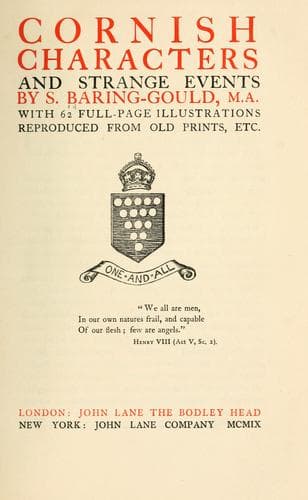
Cornish Characters and Strange EventsBaring-Gould, S. (Sabine)
History
Cornish Characters and Strange Events
Baring-Gould, S. (Sabine)
Cornwall (England : County) -- Biography; Cornwall (England : County) -- History; Legends -- England -- Cornwall (County)
Trevithick in his first locomotive had discharged the steam up the
funnel to get rid of it, but without any idea of creating a vacuum by
means of which a draught could be caused. Stephenson did the same. Mr.
Smiles has claimed that the "steam-jet" was invented by Stephenson,
but this was not the case. The steam used in Trevithick's and
Stephenson's engines was waste or exhaust steam, discharging itself
through the funnel indeed, but not filling it, so that it created no
perceptible draught.
Mr. Smiles says: "The steam after performing its duty in the cylinders
was at first allowed to escape into the open atmosphere with a hissing
blast, to the terror of horses and cattle. It was complained of as a
nuisance, and a neighbouring squire threatened to commence an action
against the colliery lessees unless it was put a stop to."
Accordingly the steam was introduced into the funnel about half-way up
at the side so as to get rid of it and obviate the objection of the
noise. But the evidence that Stephenson had discovered that it could
be employed to create a draught is inconclusive.
Goldsworthy Gurney had been placed at Wadebridge with Dr. Avery as a
medical pupil, and there he married Elizabeth Symons in 1814. He
settled down at Wadebridge as a surgeon, but his active mind would not
let him rest as a small country practitioner; he felt that he had
powers and visions that would bring him before the public as an
inventor and a benefactor. Accordingly he moved to London in 1820,
where he made the acquaintance of several able physicians, and was
called to deliver a course of lectures on the elements of chemical
science at the Surrey Institute. It was in 1823 that he began his
experiments with steam and on locomotion, and he abandoned the medical
profession in order to devote himself to these researches. His desire
was to construct an engine that would travel on common roads, and
travel at a more rapid pace than horses.
Now Stephenson, in his evidence before a Parliamentary Committee,
stated that the rate at which his locomotive travelled was "from 3 to
5 or 6 miles an hour."
"_Q._ So that these hypothetical cases of 12 miles an hour do not fall
within your general experience?
"_A._ They do not.
"_Q._ Laying aside the 12 miles an hour, I think the rate at which
these experiments were made was about 6-3/4 miles to 7?
"_A._ I think the average was 6-1/2 miles."
In the first edition of Nicholas Wood's _Treatise on Railways_, 1829,
occurs this passage: "It is far from my wish to promulgate to the
world that the ridiculous expectations, or rather professions, of the
enthusiastic specialist, will be realized, and that we shall see them
travelling at the rate of 12, 16, 18, or 20 miles an hour. Nothing
could do more harm towards their adoption or general improvement than
the promulgation of such nonsense."
Public-domain text, read in full here on John Shaqi.
Reviews
Reviews
No reviews yet
Be the first to share your thoughts on this work.
Elsewhere in the archive
Join the Discussion
Join the discussion
Sign in to leave a comment or review.
Sign InorCreate an account