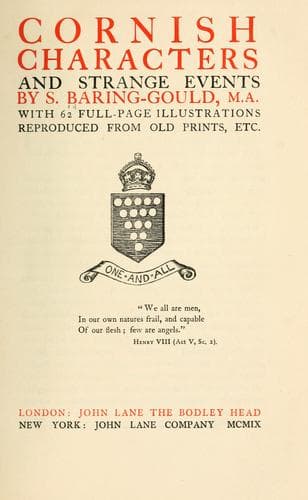
Cornish Characters and Strange EventsBaring-Gould, S. (Sabine)
History
Cornish Characters and Strange Events
Baring-Gould, S. (Sabine)
Cornwall (England : County) -- Biography; Cornwall (England : County) -- History; Legends -- England -- Cornwall (County)
Moreover, it soon became evident that the Dissenters themselves did
not desire Comprehension. Their ministers were petted and made much of
by the well-to-do yeomen and the rich merchants in country and town.
They lived on the fat of the land, snapped up wealthy widows and
bought broad acres. Whereas the needy country parson was hard pressed
to wring the tithes from his parishioners. While the walls of
exclusion of Jericho stood, the rams' horns brayed against them daily,
and seven times on the Sabbath; but so soon as the walls were
prostrate, and every man could go up into the city and take up his
quarters there where he liked, the rams' horns would have to be laid
aside as superfluous lumber.
The King was disappointed and offended. What he did was to prorogue
Convocation for six weeks, and when those six weeks had expired, to
prorogue it again, and many years elapsed before it was again suffered
to assemble.
That Convocation of 1689 saved the Church of England from dissolution
into a formless, gelatinous, and invertebrate mass.
Burnet himself, though disappointed at the time, felt afterwards that
the determination of the Lower House had saved the Church at a time of
crisis. "There was," he says, "a very happy direction of the
providence of God observed in this matter. The Jacobite clergy who
were then under suspension were designing to make a schism in the
Church, whensoever they should be turned out and their places should
be filled up by others. They saw it would not be easy to make a
separation upon a private and personal account; they therefore wished
to be furnished with more specious pretences, and if we had made
alterations in the Rubrics and other parts of the Common Prayer, they
would have pretended that they still stuck to the ancient Church of
England, in opposition to those who were altering it and setting up
new models. And, as I do firmly believe that there is a wise
providence that watches upon human affairs, and directs them--so I
have observed this in many instances relating to the Revolution ... by
all the judgments we could afterwards make, if we had carried a
majority in the Convocation for alterations, they would have done us
more hurt than good."
Burnet was morally and intellectually incapable of seeing that it was
a case of conscience, of _stantis vel cadentis ecclesiæ_, and he
attributed the motives of the recalcitrant clergy to political
prejudice.
On Jane's return to Oxford, he found another opportunity of defending
the Church, by framing the decree of 1690, which condemned the "Naked
Gospel" of Arthur Burge.
Public-domain text, read in full here on John Shaqi.
Reviews
Reviews
No reviews yet
Be the first to share your thoughts on this work.
Elsewhere in the archive
Join the Discussion
Join the discussion
Sign in to leave a comment or review.
Sign InorCreate an account