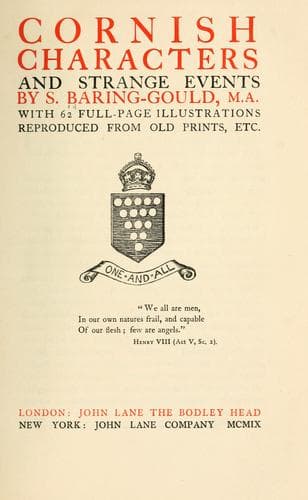
Cornish Characters and Strange EventsBaring-Gould, S. (Sabine)
History
Cornish Characters and Strange Events
Baring-Gould, S. (Sabine)
Cornwall (England : County) -- Biography; Cornwall (England : County) -- History; Legends -- England -- Cornwall (County)
As Macaulay says: "This theory (of passive obedience) at first
presented itself to the Cavalier as the very opposite of slavish. Its
tendency was to make him not a slave, but a free man and a master. It
exalted him by exalting one whom he regarded as his protector, as his
friend, as the head of his beloved party, and of his more beloved
Church. When Republicans were dominant the Royalist had endured wrongs
and insults which the restoration of the legitimate government had
enabled him to retaliate. Rebellion was therefore associated in his
imagination with subjection and degradation, and monarchical authority
with liberty and ascendancy. It had never crossed his imagination that
a time might come when a King, a Stuart, could prosecute the most
loyal of the clergy and gentry with more than the animosity of the
Rump or the Protector. That time had however arrived. Oppression
speedily did what philosophy and eloquence would have failed to do.
The system of Filmer might have survived the attacks of Locke; but it
never recovered from the death-blow given by James."
Jane changed his opinion indeed, but so did nearly the whole of the
Tory party and of the clergy of the Church.
THE PENNINGTONS
About seven years ago I attended the baptism of some bells for a new
church at Châteaulin, in Brittany. The ceremony was quaint, archaic,
and grotesque. The bells were suspended in the chancel "all of a row,"
dressed in white frocks with pink sashes round their waists. To each
was given god-parents who had to answer for them, and each was
actually baptized, after which each was made to speak for itself. The
ceremony evidently dates from a period when the bell was regarded as
anything but an inanimate object--it had its responsibilities, it did
its duties, it spoke in sonorous tones. The very inscriptions on them
to the present day prescribe something of this character--invest each
bell with a personality, as these:--
I sweetly tolling men do call
To taste of meats to feed the soul.
Also:--
I sound to bid the sick repent,
In hope of life when breath is spent.
As late as last century we find these:--
Both day and night I measure time for all,
To mirth and grief, to church I call.
And this in 1864:--
I toll the funeral knell,
I ring the festal day,
I mark the fleeting hours,
And chime the church to pray.
Public-domain text, read in full here on John Shaqi.
Reviews
Reviews
No reviews yet
Be the first to share your thoughts on this work.
Elsewhere in the archive
Join the Discussion
Join the discussion
Sign in to leave a comment or review.
Sign InorCreate an account