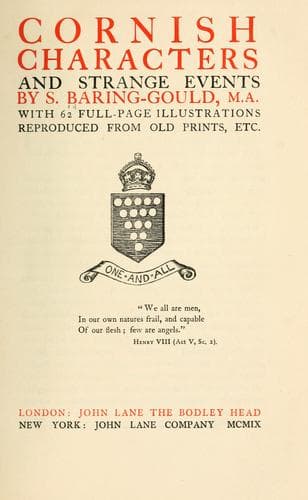
Cornish Characters and Strange EventsBaring-Gould, S. (Sabine)
History
Cornish Characters and Strange Events
Baring-Gould, S. (Sabine)
Cornwall (England : County) -- Biography; Cornwall (England : County) -- History; Legends -- England -- Cornwall (County)
"The small village afforded neither medical aid nor fresh provisions,
of which we stood so much in need, potatoes and salt fish being the
only food of the inhabitants. I determined, therefore, to lose no time
in proceeding to S. John's, having hired a small schooner for that
purpose. On the 7th July we embarked in three divisions, placing the
most infirm in the schooner, the master's mate being in charge of the
cutter, and the boatswain of the jolly-boat; but such was the
exhausted state of nearly the whole party, that the day was
considerably advanced before we could get under way.
"Towards dusk it came on to blow hard in squalls off the land, when we
lost sight of the cutter, and were obliged to come to anchor outside
S. John's Harbour. We were under great apprehensions for the cutter's
safety, as she had no grapnel, and lest she should be driven out to
sea, but at daylight we perceived her and the schooner entering the
harbour.
"The ladies, Colonel Cooke, Captain Thomas, and myself, having left
the schooner when she anchored, notwithstanding the badness as well as
extreme darkness of the night, reached the shore about midnight. We
wandered for some time about the streets, there being no house open at
that late hour, but were at length admitted into a small tenement,
where we passed the remainder of the night on chairs, there being but
one miserable bed for the ladies. Early on the following day, our
circumstances being made known, hundreds of people crowded down to the
landing-place. Nothing could exceed their surprise on seeing the
boats that had carried twenty-nine persons such a distance over a
boisterous sea, and when they beheld so many miserable objects, they
could not conceal their emotions of pity and concern."
It was found that the greatest circumspection had to be used in
administering nourishment to those who came on shore. They were so much
frost-bitten, moreover, as to require constant surgical assistance. Many
had lost their toes, and they were constrained to remain at S. John's
till they were in a fit state to be removed to Halifax.
On the 11th July Captain Fellowes, with Captain Thomas, and
Lieutenant-Colonel Cooke, engaged the cabin of a small vessel, bound
for Oporto, so as to return to England.
When Captain Fellowes sent in his report on the loss of the _Lady
Hobart_, he added a postscript: "I regret that, in the hurry of
drawing up this narrative, I should have omitted to make particular
mention of Captain Richard Thomas, R.N., from whose great professional
skill and advice throughout our perilous voyage I derived the greatest
assistance."
In December, 1803, Captain Thomas commissioned the _Ætna_ bomb, and
soon after joined the fleet under Lord Nelson in the Mediterranean
station, where he was very actively employed up to the battle of
Trafalgar. After that he served as flag-captain under his old friend
and patron, Lord Collingwood.
Public-domain text, read in full here on John Shaqi.
Reviews
Reviews
No reviews yet
Be the first to share your thoughts on this work.
Elsewhere in the archive
Join the Discussion
Join the discussion
Sign in to leave a comment or review.
Sign InorCreate an account