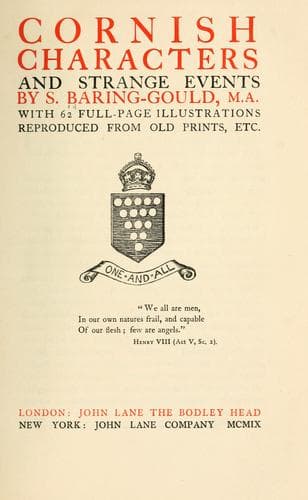
Cornish Characters and Strange EventsBaring-Gould, S. (Sabine)
History
Cornish Characters and Strange Events
Baring-Gould, S. (Sabine)
Cornwall (England : County) -- Biography; Cornwall (England : County) -- History; Legends -- England -- Cornwall (County)
"She was likewise in face and person the very model of her son
Samuel--short, fat, and flabby, with an eye that eternally gave the
signal for mirth and good humour; in short, she resembled him so much
in all her movements, and so strongly identified his person and
manners, that by changing habits they might be thought to have
interchanged sexes."
After leaving school Samuel Foote received his education at Worcester
College, Oxford, formerly Gloucester Hall, which owed its refoundation
and change of name to Sir Thomas Cooke, Bart., a second cousin of
Samuel.
The church connected with the college fronted a lane, where cattle
were sometimes turned out to graze during the night, and the bell-rope
hung very low in the middle of the outside porch. Foote one night made
a loop in the cord and inserted a wisp of hay. One of the cows
smelling this seized it, and by tugging at the rope made the bell
ring, and continue to ring at jerky intervals till the hay was
consumed. This produced consternation in the neighbourhood; people ran
out of their houses thinking that there must be a fire somewhere. The
same happened next and the following nights, and it was concluded that
the church was haunted. But Dr. Gower, the then provost, and the
sexton sat up one night and watched, and discovered that this was a
prank of one of the scholars.
From the University Foote was removed to the Temple, but the dryness
of the law was not to his taste, and he turned to the stage.
His first appearance was in the part of Othello at the Haymarket
Theatre, February 6th, 1747. But as Macklin said on this occasion, "it
was little better than a total failure. Neither his figure, voice, nor
manners corresponded with the character; and in those mixed passages
of tenderness and rage the former was expressed so whiningly, and the
latter in a tone so sharp and inharmonious, that the audience could
scarcely refrain from laughing."
Probably he speedily saw that his genius did not lie in the direction of
tragedy, and he soon struck out into a new and untrodden path, in which
he at once attained the two great ends of affording entertainment to the
people and gaining emolument for himself. He opened the Haymarket
Theatre in the spring of 1747 with a piece of his own writing, entitled
_The Diversions of the Morning_. This consisted of a mimicry of the
best-known men of the day--actors, doctors, lawyers, statesmen. Had he
contented himself with this he might not have been interfered with, but
to the piece of mimicry he added the performance of popular farces--and
he had failed to procure a licence. To evade this difficulty he
announced his entertainment as a Concert of Music, after which would be
given _gratis_ his _Diversions_ and a play.
The managers of the patent houses could not tolerate such an
infringement of their rights. They appealed to the Westminster
magistrates, and on the second night the constables entered the
theatre and dispersed the audience.
Public-domain text, read in full here on John Shaqi.
Reviews
Reviews
No reviews yet
Be the first to share your thoughts on this work.
Elsewhere in the archive
Join the Discussion
Join the discussion
Sign in to leave a comment or review.
Sign InorCreate an account