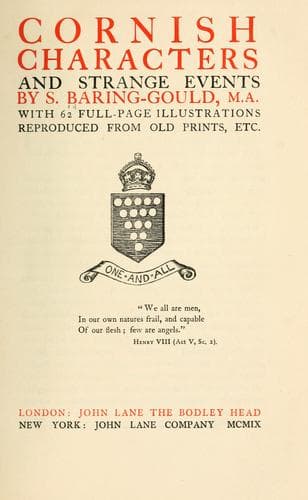
Cornish Characters and Strange EventsBaring-Gould, S. (Sabine)
History
Cornish Characters and Strange Events
Baring-Gould, S. (Sabine)
Cornwall (England : County) -- Biography; Cornwall (England : County) -- History; Legends -- England -- Cornwall (County)
"The grand jury of Middlesex," says Macaulay, "consisting of gentlemen
of note, found a bill of murder against Hill and Mohun. Hill escaped.
Mohun was taken. His mother threw herself at King William's feet, but
in vain. 'It was a cruel act,' said the King. 'I shall leave it to the
law.'
"The trial came on in the Court of the Lord High Steward, and, as
Parliament happened to be sitting, the culprit had the advantage of
being judged by the whole body of the peerage. There was then no
lawyer in the Upper House. It therefore became necessary, for the
first time since Buckhurst had pronounced sentence on Essex and
Southampton, that a peer who had never made jurisprudence his special
study should preside over that grave tribunal. Caermarthen, who, as
Lord President, took precedence of all the nobility, was appointed
Lord High Steward. A full report of the proceedings has come down to
us. No person, who carefully examines that report, and attends to the
opinion unanimously given by the judges in answer to a question which
Nottingham drew up, and in which the facts brought out by the evidence
are stated with perfect fairness, can doubt that the crime of murder
was fully brought home to the prisoner. Such was the opinion of the
King, who was present during the trial; and such was the almost
unanimous opinion of the public. Had the issue been tried by Holt and
twelve plain men at the Old Bailey, there can be no doubt that a
verdict of Guilty would have been returned. The Peers, however, by
sixty-nine votes to fourteen, acquitted their accused brother. One
great nobleman was so brutal and stupid as to say, 'After all, the
fellow was but a player; and players are rogues.' All the newspapers,
all the coffee-house orators complained that the blood of the poor was
shed with impunity by the great. Wits remarked that the only fair
thing about the trial was the show of ladies in the galleries. Letters
and journals are still extant in which men of all shades of opinion,
Whigs, Tories, Non-jurors, condemn the partiality of the tribunal."
On the one hand, the words of the dying man exculpated Mohun from any
share in the actual murder; on the other hand, it is clear from the
uncontradicted testimony of more than one witness, that he was fully
cognizant of Hill's intentions, and that he did not hesitate to
encourage him by his presence through the whole affair. According to
the Attorney-General, his first question, when he surrendered himself,
was, "Has Mr. Hill escaped?" and, upon being answered in the
affirmative, he exclaimed, "I am glad of it! I should not care if I
were hanged for him," his only regret being that Hill had escaped with
very little money about him. He confessed, moreover, to the watch,
that he had changed coats with his friend; the object, of course, was
to throw out the pursuers as much as possible by this slight disguise.
Public-domain text, read in full here on John Shaqi.
Reviews
Reviews
No reviews yet
Be the first to share your thoughts on this work.
Elsewhere in the archive
Join the Discussion
Join the discussion
Sign in to leave a comment or review.
Sign InorCreate an account