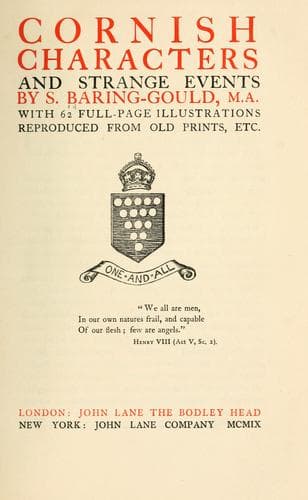
Cornish Characters and Strange EventsBaring-Gould, S. (Sabine)
History
Cornish Characters and Strange Events
Baring-Gould, S. (Sabine)
Cornwall (England : County) -- Biography; Cornwall (England : County) -- History; Legends -- England -- Cornwall (County)
Cornwall has no great cause to boast of William Noye as her son. He
was undoubtedly a shrewd, subtle, and learned lawyer; but he was
wholly without principle and consistency.
He was the son of Edward Noye, of Carnanton, in Mawgan parish, and
grandson of William Noy, or Noye, of Pendrea, in Buryan. He was born at
this latter place, it is asserted, in 1577. In 1593 he entered Exeter
College, Oxford, and thence removed to Lincoln's Inn to study common
law. He represented Grampound in Parliament 1603-14, Fowey 1623-5, S.
Ives 1625-7, Helston 1627-31. In Parliament he proved himself an able
and determined opponent to the encroachment of the Royal prerogative.
Hals says: "In the beginning of the reyne of King Charles I he was
specially famous for beinge one of the boldest and stoutest champions of
the subjects' liberty in Parliament that the western parts of England
afforded; which beinge observed by the Court party, Kinge Charles was
advised by his Cabinet Councill that it wold be a prudent course to
divert the force and power of Noye's skill, logick, and rhetorique
another waye, by givinge him som Court preferment. Whereupon Kinge
Charles made him his Attorney-General, 1631, by which expedient he was
soon metamorphized from an asserter of the subjects' liberty and
property to a most zealous and violent promoter of the despotick and
arbitrary prerogative or monarchy of his Prince; soe that like the
image of Janus at Rome, he looked forward and backward, and by means
thereof greatly enriched himself.--Amongst other things, he is reflected
upon by our chronologers for beinge the principal contriver of the
ship-money tax, layd by Kinge Charles upon his subjects for settinge
forth a navye, or fleet of shipps at sea, without the consent of Lords
or Commons in Parliament, which moneys were raysed by writt of the
sheriffs of all countys and commissioners, and for a long tyme brought
into the exchequer twenty thousand pound per mensem, to the greate
distast of the Parliament, the layety, and clergye, who declard against
it as an unlawfull tax."
Public-domain text, read in full here on John Shaqi.
Reviews
Reviews
No reviews yet
Be the first to share your thoughts on this work.
Elsewhere in the archive
Join the Discussion
Join the discussion
Sign in to leave a comment or review.
Sign InorCreate an account