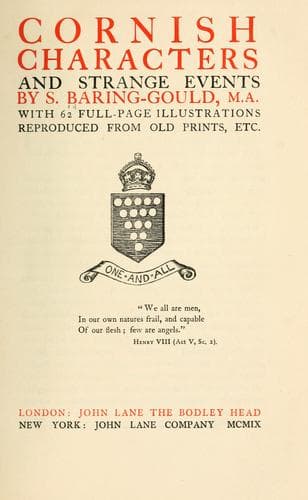
Cornish Characters and Strange EventsBaring-Gould, S. (Sabine)
History
Cornish Characters and Strange Events
Baring-Gould, S. (Sabine)
Cornwall (England : County) -- Biography; Cornwall (England : County) -- History; Legends -- England -- Cornwall (County)
That England needed a fleet to protect her could not be disputed.
Howell admits as much. "One with half an eye may see we cannot be
secure while such large fleets of men-of-war, both Spanish, French,
Dutch, and Dunkirkers, some of them laden with ammunition, men, arms,
and armies, do daily sail on our seas and confront the King's chambers
(guns), while we have only three or four ships abroad to guard our
coast and kingdom, and to preserve the fairest flower of the crown,
the dominion of the Narrow Sea, which I hear the French Cardinal
begins to question, and the Hollander lately would not vail to one of
His Majesties ships that brought over the Duke of Lenox and my Lord
Weston from Bullen (Boulogne); and indeed we are jeer'd abroad that we
send no more ships to guard our seas."[20]
Dunkirk was peculiarly obnoxious, as it was a nest of pirates that fell
on our small trading vessels, and even Algerines came with impunity to
our coasts and carried off captives as slaves in Africa. The Dutch,
taking advantage of the domestic broils in England, had greatly advanced
their commerce, and were prepared to dispute with England the command of
the Channel. They excluded English vessels from the northern fisheries,
and went so far as to claim and to exercise the right of fishing along
the English coasts. The Navy of France, moreover, was also rapidly
augmented, under the fostering care of Richelieu.
Hitherto the ports on the coast had contributed towards the defence of
the land and the protection of our shipping, but the inland towns had
been exempted. This was not reasonable, and Charles resolved on
imposing a general tax to provide England with a fleet. He had
recourse to Noye instead of placing the matter before Parliament.
Noye, says Clarendon, "was wrought upon by degrees by the great
persons that steered the public affairs to be an instrument in all
their designs, turning his learning and industry to the discovery of
sources of revenue, and to the justifying them when found--thinking
that he could not give a clearer testimony that his knowledge of the
law was greater than all other men's, than by making that law which
all other men believed to be not so. So he moulded, framed, and
pursued the odious and crying project of soap, and with his own hand
drew and prepared the writ for ship-money, both which will be lasting
monuments of his fame."
About the soap monopoly presently.
Public-domain text, read in full here on John Shaqi.
Reviews
Reviews
No reviews yet
Be the first to share your thoughts on this work.
Elsewhere in the archive
Join the Discussion
Join the discussion
Sign in to leave a comment or review.
Sign InorCreate an account