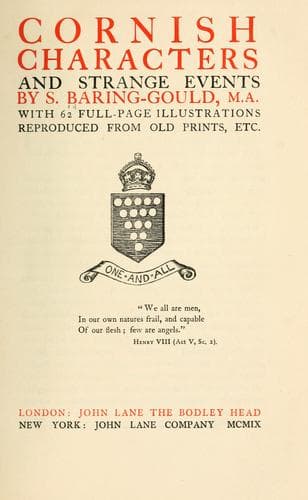
Cornish Characters and Strange EventsBaring-Gould, S. (Sabine)
History
Cornish Characters and Strange Events
Baring-Gould, S. (Sabine)
Cornwall (England : County) -- Biography; Cornwall (England : County) -- History; Legends -- England -- Cornwall (County)
His sister kept house for him. One market-day a country-woman entered
his shop, and having completed her purchases, remarked that she
thought he would be more comfortable if he had a wife. Drew assented,
but said, "I don't know any one who would have me." "Oh! that's easily
settled," said the woman, and left. Next market-day she returned,
bringing her buxom, apple-cheeked daughter with her. "There, Mr.
Drew," said she; "I brought this maid, who will make 'ee a good wife."
Samuel demurred; he neither knew the family nor the qualities and
character of the wench.
"Lor' bless 'ee!" said the woman, when he made these objections, "take
her. The trial of the pudding is in the eating."
He declined the proposal, however; but this incident turned his mind
to matrimony, and on April 17th, 1791, when in his twenty-seventh
year, he married Honor Halls, and by her had five sons and three
daughters. His wife's immediate fortune was £10, a sum of great
importance at that time to him. Three years after it was increased by
a legacy of £50.
Having made a certain amount of success with his _Essay on the
Immortality of the Soul_, Drew next undertook one on _The Identity and
Resurrection of the Human Body_, and this was published in 1809.
Into a controversy he was engaged in with Mr. Polwhele in 1800 on
Methodism we need not enter, but it made no breach of friendly feeling
between Mr. Polwhele and him, and it was at the request of the former
that Drew wrote the little account of his life that appeared in
Polwhele's _Literary Characters_, 1803.
Having experienced his own great difficulties in acquiring the
principles of the English grammar, in 1804 he gave a course of
lectures on that subject. These lectures, which occupied about two
hours, were delivered on four evenings of the week, two being allotted
to each sex separately. A year completed the course of instruction,
and for this each pupil paid thirty shillings. He was able to
illustrate his lectures very happily with anecdote and from his own
experience, so as to render the barren study of grammar interesting
and entertaining. Though never able to write first-class English, and
often clumsy in diction, yet he was studiously correct in grammar, if
often awkward in construction of a sentence.
In the year 1805 he gave up his cobbling business and devoted himself
entirely to his pen. Seeing his value as a polemic writer in favour of
the fundamental doctrines of Christianity, several of the clergy of
Cornwall were anxious that he should join the Church; but his early
association with Dissent, and his ignorance of Catholic doctrine,
induced him to remain where he was in the Methodist Connection.
He next wrote an _Essay on the Being and Attributes of the Deity_, and
a reply to Thomas Prout, _On the Divinity of Christ and the Eternal
Sonship_. All this was very well in its way at the time, but is now so
much waste paper, used only for covering jampots.
Public-domain text, read in full here on John Shaqi.
Reviews
Reviews
No reviews yet
Be the first to share your thoughts on this work.
Elsewhere in the archive
Join the Discussion
Join the discussion
Sign in to leave a comment or review.
Sign InorCreate an account