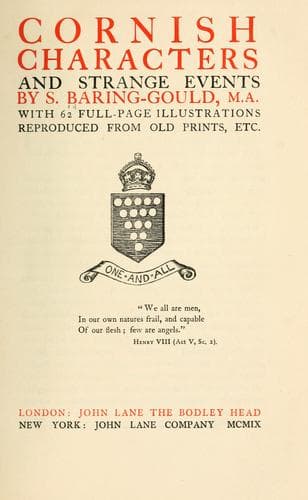
Cornish Characters and Strange EventsBaring-Gould, S. (Sabine)
History
Cornish Characters and Strange Events
Baring-Gould, S. (Sabine)
Cornwall (England : County) -- Biography; Cornwall (England : County) -- History; Legends -- England -- Cornwall (County)
"Young as I was, I shall never forget our falling in with the _Pickle_
schooner off Trafalgar, carrying the first despatches of the battle
and death of its hero. Her commander, burning with impatience to be
the first to convey the news to England, was compelled to heave to and
come on board us. Captain Keates received him on deck, and when he
heard the news I was by his side. Silence reigned throughout the ship;
some great event was anticipated. The officers stood in groups,
watching with intense anxiety the two commanders, who walked apart.
'Battle,' 'Nelson,' 'ships,' were the only audible words which could
be gathered from their conversation. I saw the blood rush into
Keates's face; he stamped the deck, walked hurriedly, and spoke with
passion. I marvelled, for I had never before seen him much moved; he
had appeared cool, firm, and collected on all occasions, and it struck
me that some awful event had taken place, or was at hand. The Admiral
was still in his cabin, eager for news from the Nelson fleet. He was
an irritable and violent man, and after a few minutes, swelling with
wrath, he sent an order to Keates, who possibly heard it not, but
staggered along the deck, struck to the heart by the news, and, for
the first time in his life, forgot his respect to his superior in
rank; muttering, as it seemed, curses on his fate that, by the
Admiral's delay, he had not participated in the most glorious battle
in naval history. Another messenger enforced him to descend in haste
to the Admiral, who was high in rage and impatience.
"Keates, for I followed him, on entering the Admiral's cabin said in a
subdued voice, as if he were choking, 'A great battle has been fought,
two days ago, off Trafalgar. The combined fleets of France and Spain
are annihilated, and Nelson is no more!' He then murmured, 'Had we not
been detained we should have been there.'
"Duckworth answered not, conscience-struck, but stalked the deck. He
seemed ever to avoid the look of his captain, and turned to converse
with the commander of the schooner, who replied in sulky brevity,
'Yes' or 'No.' Then, dismissing him, he ordered all sail to be set,
and walked the quarter-deck alone. A death-like stillness pervaded the
ship, broken at intervals by the low murmurs of the crew and officers,
when 'battle' and 'Nelson' could alone be distinguished. Sorrow and
discontent were painted on every face.
"On the following morning we fell in with a portion of the victorious
fleet. It was blowing a gale, and they lay wrecks on the sea. Our
Admiral communicated with them, and then, joining Collingwood, had six
sail of the line put under his command, with orders to pursue that
part of the enemy's fleet which had escaped; and I joined the ship to
which I was appointed. It is unnecessary to dwell on the miseries of a
cockpit life: I found it more tolerable than my school, and little
worse than my home."
Public-domain text, read in full here on John Shaqi.
Reviews
Reviews
No reviews yet
Be the first to share your thoughts on this work.
Elsewhere in the archive
Join the Discussion
Join the discussion
Sign in to leave a comment or review.
Sign InorCreate an account