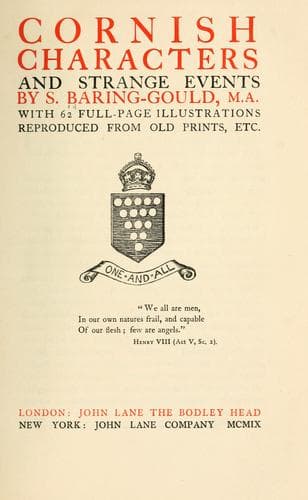
Cornish Characters and Strange EventsBaring-Gould, S. (Sabine)
History
Cornish Characters and Strange Events
Baring-Gould, S. (Sabine)
Cornwall (England : County) -- Biography; Cornwall (England : County) -- History; Legends -- England -- Cornwall (County)
"The port of Falmouth," wrote he in his unfinished memoirs, "being
nearest to the entrance of the Channel, there were permanently
stationed here two squadrons of frigates, one under the command of Sir
Edward Pellew (afterwards Lord Exmouth), the other under the command
of Sir John Borlase Warren. The former, as commodore, hoisted his
pennant on the _Indefatigable_, the latter on the _Révolutionaire_.
Each squadron consisted of five frigates of thirty-two and forty-four
guns each; and, in addition to these, there were continually arriving
and departing from Carrick Roads, the outer anchorage of Falmouth,
line-of-battle ships and smaller vessels of war; while the prizes
taken from the French were constantly brought into the port for
adjudication and sale. There were two large prisons, with open courts,
for the reception of the French prisoners thus taken, and every month
added many to their inmates.
"Both the naval commodores, as well as such captains of the frigates
belonging to the squadrons as were married, had their families residing
at Flushing, and the numerous officers of different grades, from the
youngest midshipman to the first lieutenant, were continually coming and
going to and fro ... so that the little village literally sparkled with
gold epaulets and gold-laced hats and brilliant uniforms."
He tells a curious story of his childhood. Corn, owing to the war, had
mounted to famine price, and the miners of Cornwall went about in
gangs waging war against all forestallers, regraters, and hoarders
of grain, and demolishing bakers' shops, mills, and grain stores.
[Illustration: JAMES SILK BUCKINGHAM]
"A body of some three or four hundred of these men entered Flushing,
and as they were all dressed in the mud-stained smock frocks and
trousers in which they worked underground, all armed with large clubs
and sticks of various kinds, and speaking an uncouth jargon, which
none but themselves could understand, they struck terror wherever they
went. Their numbers were quite equal to the whole adult male
population of the little village, so that the men stood aghast, the
women retired into their houses, and closed their doors, and the
children seemed struck dumb with affright. The moment of their visit,
too, was most inopportune, for on that very day a large party of the
captains and officers of the packets residing at Flushing were
occupied in storing a cargo of grain that had just been discharged
from a coasting vessel at the quay, and locking it up in warehouses to
secure it from plunder."
At this time it happened that all the ships of war were absent on
their cruising grounds. The situation was dangerous, and the men
threatened an attack on the warehouses, and were muttering and
brandishing their clubs, and falling into ranks, when Captain
Kempthorne snatched up little James Silk, then an urchin of six or
seven, seated him on a sack of corn, and bade him strike up a hymn.
With his shrill little pipe, he started--
Public-domain text, read in full here on John Shaqi.
Reviews
Reviews
No reviews yet
Be the first to share your thoughts on this work.
Elsewhere in the archive
Join the Discussion
Join the discussion
Sign in to leave a comment or review.
Sign InorCreate an account