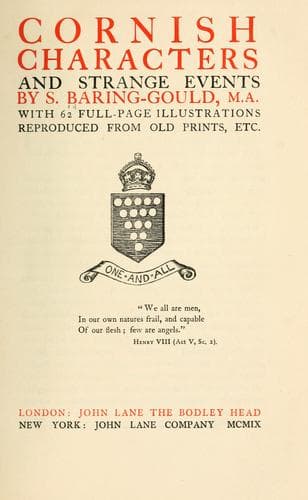
Cornish Characters and Strange EventsBaring-Gould, S. (Sabine)
History
Cornish Characters and Strange Events
Baring-Gould, S. (Sabine)
Cornwall (England : County) -- Biography; Cornwall (England : County) -- History; Legends -- England -- Cornwall (County)
Whilst there, in May, 1815, Buckingham had the offer of the command of
the _Humayoon Shah_, a vessel built at the Portuguese port of Damann,
north of Bombay, by the Imaum of Muscat, for trade with China. The
retiring captain, named Richardson, in three successive voyages had
cleared £30,000, and the situation had been sought by several of the
marine officers of the East India Company. When these disappointed men
heard that Buckingham had secured the appointment, they were angry,
and applied to the Company to eject him from India and close every
port there in their power against him. This they did by refusing him a
licence to remain in India.
The British Government, in granting a charter of exclusive trade to
India and China to the East India Company, gave that Company thereby a
right to expel from their dominions all British-born subjects who had
not their licence to reside there, this being deemed necessary to
protect them from the competition of "interlopers" as they were
called, who might undersell them in their own markets. But though the
British Government might thus condemn all the twenty million of its
own native-born subjects to this state of ignominious dependence on
the will or caprice of a handful of monopolists, a body of some
twenty-four directors only--in whose hands lay the power of granting
licences or banishing those who did not possess them--it could not
authorize the exercise of such powers against the natives of any
foreign state; consequently James Silk Buckingham was advised to
become nationalized as an American citizen, in which case the East
India Company would be powerless to expel him.
In point of fact, the case stood thus: all foreigners who had no natural
claim on India as a part of their dominions might visit it freely and
reside and trade in it as long as they pleased, without licence from its
rulers; whereas British-born subjects, who had contributed by their
payment of taxes to support the very Government that made the charter,
were unjustly excluded, although the conquest of India had been made by
British blood and British treasure, and the country was still held under
the British flag. In short, all foreigners were free men there, and the
freeborn Englishman alone was a slave.
Buckingham so felt the iniquity of this system that later, when he
came to England, he agitated and wrote against the continuance of the
charter.
Public-domain text, read in full here on John Shaqi.
Reviews
Reviews
No reviews yet
Be the first to share your thoughts on this work.
Elsewhere in the archive
Join the Discussion
Join the discussion
Sign in to leave a comment or review.
Sign InorCreate an account