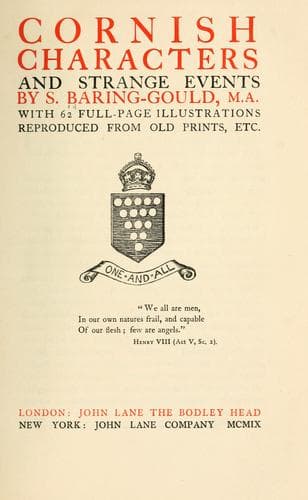
Cornish Characters and Strange EventsBaring-Gould, S. (Sabine)
History
Cornish Characters and Strange Events
Baring-Gould, S. (Sabine)
Cornwall (England : County) -- Biography; Cornwall (England : County) -- History; Legends -- England -- Cornwall (County)
Robespierre was executed on 28th July, 1794; and soon after his death
the Convention decreed the release of great numbers of "suspects" and
other prisoners. It was not, however, till August, 1795, that Henry
Carter got his passport and was able to leave. He arrived at Falmouth
on August 22nd. "Arived on shore aboute three o'clock in the afternoon
with much fear and trembling, where I meet with my dear little
(daughter) Bettsy, there staying with her aunt, Mrs. Smythe, then
between 8 and 9 years old.... I staid that night at Falmouth, the next
morning went to Penryn with my dear little Bettsey in my hand. The next
morning, on Sunday, took a horse and arrived at Breage Churchtown aboute
eleven o'clock, where I meet my dear brother Frank, then in his way to
church. As I first took him in surprise, at first I could harly make him
sensable I was his brother, being nearley two years without hearing
whether I was dead or alife. But when he come to himself as it were, we
rejoiced together with exceeding great joy indeed. We went to his house
in Rinsey, and after dinner went to see brother John (in Prussia Cove).
We sent him word before I was coming. But he could harly believe it. But
first looking out with his glass saw me yet a long way off. Ran to meet
me, fell upon my neck. We passed the afternoon with him, and in the
evning went to Keneggy to see brother Charles."
The autobiography ends abruptly in the year 1795, but the writer lived
on until April 19th, 1829, spending the last thirty years of his life
on a little farm at Rinsey.
In addition to the two authorities quoted, both due to Mr. Cornish,
there is a memoir of Henry Carter in the _Wesleyan Methodist Magazine_
for October, 1831.
FOOTNOTE:
[29] J. B. Cornish in the _Cornish Magazine_, 1898, p. 121.
CAPTAIN RICHARD KEIGWIN
The English East India Company had been founded December 31st, 1600,
and it obtained from Queen Elizabeth the exclusive privilege for
fifteen years of trading with India and all countries to the east of
the Cape of Good Hope, in Africa and in Asia. The first settlement
effected was at Surat in 1612, by Captain Thomas Best, who defeated
the Portuguese in two battles. But through the jealousy of the Dutch
and their encroachments, and the disturbances in England caused by the
Great Rebellion, the East India Company fell to decay. Although
Cromwell in 1657 renewed its privileges, the English made little
headway. On April 3rd, 1661, Charles II confirmed and renewed all the
ancient privileges, and handed over to the Company Bombay, which he
had received from Spain as the portion of Catherine of Braganza.
Public-domain text, read in full here on John Shaqi.
Reviews
Reviews
No reviews yet
Be the first to share your thoughts on this work.
Elsewhere in the archive
Join the Discussion
Join the discussion
Sign in to leave a comment or review.
Sign InorCreate an account