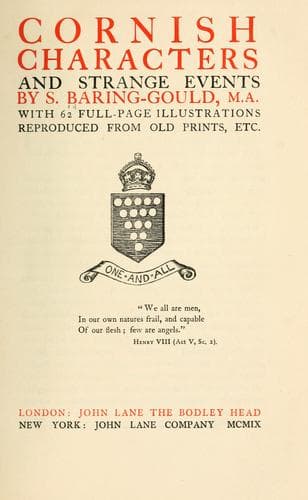
Cornish Characters and Strange EventsBaring-Gould, S. (Sabine)
History
Cornish Characters and Strange Events
Baring-Gould, S. (Sabine)
Cornwall (England : County) -- Biography; Cornwall (England : County) -- History; Legends -- England -- Cornwall (County)
In order that he might represent the danger that menaced of losing
Bombay Captain Keigwin resolved on reporting in person to the Company
how matters stood, and he accordingly went to the directors and laid
the case before them with such force that they consented to send him
back to Bombay with the rank of captain-lieutenant, and he was to be
third in the Council. But with singular capriciousness, in the
following year, when Keigwin was at Bombay, they rescinded the order,
reduced his pay to six shillings a day, without allowance for food and
lodging, and made further reductions in the general pay and increase
in the taxes. This embittered the garrison and the natives alike.[30]
"During the greater part of the reign of Charles the Second," says
Macaulay, "the Company enjoyed a prosperity to which the history of
trade scarcely furnishes a parallel, and which excited the wonder, the
cupidity, and the envious animosity of the whole capital. Wealth and
luxury were then rapidly increasing, the taste for spices, the tissues
and the jewels of the East, became stronger day by day; tea, which at
the time when Monk brought the army of Scotland to London had been
handed round to be stared at and just touched with the lips, as a
great rarity from China, was, eight years later, a regular article of
import, and was soon consumed in such quantities that financiers began
to consider it as a fit subject for taxation." Coffee, moreover, had
become a fashionable drink, and the coffee-houses of London were the
resorts of every description of club. But coffee came from Mocha, and
the East India Company had sole right to import that, as it had
absolute monopoly of the trade of the Indian Sea.
Nor was that all; vast quantities of saltpetre were imported into
England from the East for the manufacture of gunpowder. But for this
supply our muskets and cannon would have been speechless. It was
reckoned that all Europe would hardly produce in one year saltpetre
sufficient for the siege of one town fortified on the principles of
Vauban.
The gains of the Company were enormous, so enormous as in no way to
justify the cheeseparing that was had recourse to at Bombay. But these
gains were not distributed among a large number of shareholders, but
swelled the pockets of a few, for as the profits increased the number
of holders of stock diminished.
The man who obtained complete control over the affairs of the Company
was Sir Josiah Child, who had risen from an apprentice who swept out
one of the counting-houses in the City to great wealth and power. His
brother John was given an almost uncontrolled hand at Surat.
Public-domain text, read in full here on John Shaqi.
Reviews
Reviews
No reviews yet
Be the first to share your thoughts on this work.
Elsewhere in the archive
Join the Discussion
Join the discussion
Sign in to leave a comment or review.
Sign InorCreate an account