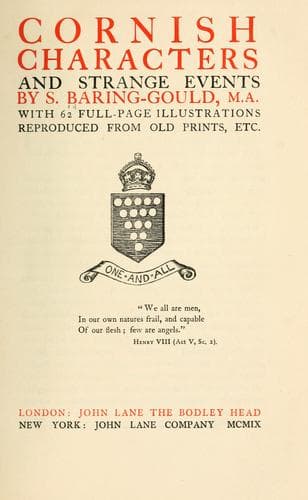
Cornish Characters and Strange EventsBaring-Gould, S. (Sabine)
History
Cornish Characters and Strange Events
Baring-Gould, S. (Sabine)
Cornwall (England : County) -- Biography; Cornwall (England : County) -- History; Legends -- England -- Cornwall (County)
The end of this man, Ali Pasha, may be briefly told. He had become
independent, disregarding the authority of the Sultan, and a menace to
the State. Accordingly an army was despatched to Janina, and a fleet
to make a descent on the coasts of Epirus. Ali, in spite of his great
age, exhibited great energy, and prepared to resist, but his fatal
avarice stood in his way. With his enormous treasures he could have
secured the fidelity of his troops, but he could not make up his mind
to deal liberally with his defenders, and most deserted. His own sons
and grandsons, with one exception, passed over into the enemy's camp.
He set the town of Janina on fire, and retired himself into the
fortress, which was defended by Italian and French artillerymen, and
which bristled with cannon. This was in August, 1820. At the beginning
of 1821 the Sultan gave the command of his forces to Khorchid Pasha,
and the siege was begun. Ali had previously sunk one portion of his
treasure in the lake in spots where it could be recovered by himself
when the storm blew over; the rest was in his cellar heaped up over
barrels of gunpowder, and a faithful attendant stood ever by with a
lighted fuse in his hand. Khorchid was particularly desirous of
securing the treasure. He proposed an interview in an island of the
lake. After some hesitation Ali, who had now but fifty men in his
garrison, consented. The interview took place on the 5th February,
1822; Khorchid had taken the precaution to surround the island with
soldiers, but concealed. When they met, the officer of the Sultan
produced a firman granting complete forgiveness to Ali for all his
crimes and defiance, on condition that he surrendered some of his
treasures. Ali then drew off his ring, handed it to the general, and
said, "Show that to my slave, and he will extinguish the fuse."
Ali was detained in the palace on the isle till messengers had been
sent to the fortress, and the slave, obedient to the token, had put
out the light, whereupon he was at once stabbed. When Khorchid knew
that the treasure was secure, he summoned the soldiery, and they fired
into the kiosk from all sides and through the floor, till Ali was
struck mortally.
The moral infamies of this man are not to be described.
When the negotiations with Ali Pasha were ended, the Lord High
Commissioner and the ladies returned to Corfu, and Sir Charles Penrose
went back to his fleet.
He returned to England in 1819, being succeeded in his command by
Admiral Freemantle.
He again made Ethy his home, taking occasional flights to London to
obtain some other naval appointment, which would not compel a
severance from his family, but none was available, and, finally, as
his wife's health and his own began to fail, he was content to remain
in his quiet Cornish home. There he died January 1st, 1830, at the age
of seventy; and Lady Penrose died in 1832.
Public-domain text, read in full here on John Shaqi.
Reviews
Reviews
No reviews yet
Be the first to share your thoughts on this work.
Elsewhere in the archive
Join the Discussion
Join the discussion
Sign in to leave a comment or review.
Sign InorCreate an account