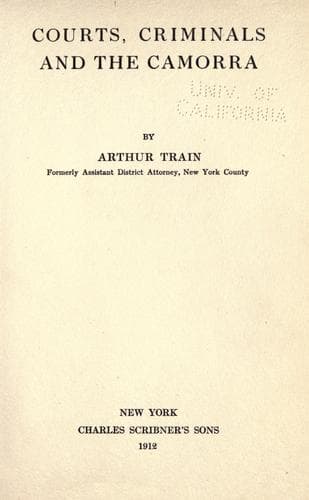
Courts, Criminals and the CamorraTrain, Arthur Cheney
History
Courts, Criminals and the Camorra
Train, Arthur Cheney
Camorra; Criminals -- United States; Justice, Administration of -- United States
It is a cool spring morning, and the small crowd which daily gathers
to watch the arrival of the prisoners in their black-covered wagons
has dispersed; the guard of infantry has marched back to the Rocca,
once the castle of the popes and now a barracks; and only a couple of
carabinieri stand before the door, their white-gloved hands clasped
before their belts. Inside, in the extreme rear of the church, you
find yourself in a small inclosure seating a couple of hundred people,
and a foot or so lower than the level of the rest of the building.
This is full of visitors from Rome, wives of lawyers, townspeople,
and a scattering of English and American motorists. A rail separates
this—the only provision for spectators—from the real court. (At the
Thaw and Patterson trials the guests of the participants and officials
swarmed all over the court-room, around and beside the jury-box, inside
the rail at which the prisoners were seated, and occasionally even
shared the dais with the judge.)
We will assume that the proceedings have not yet begun, and that
the advocates in their black gowns are chatting among themselves or
conferring with their clients through the bars of the cage, which is
built into the right-hand side of the church and completely fills it.
This cage, by the way, is an absolute necessity where large numbers of
prisoners are tried together. The custom of isolating the defendant in
some such fashion is not peculiar to Italy, but is in use in our own
country as well; and if one attends a criminal trial in the city of
Boston he will see the accused elevated in a kind of temporary cell
in the middle of the court-room, and looking as if he were suspended
in a sort of human bird-cage. Where, as in most jurisdictions of
the United States, every defendant can demand a separate trial as
of right (which he almost inevitably does demand), no inconvenience
is to be anticipated from allowing him his temporary freedom while
in the court-room in the custody of an officer. But there are many
cases, where three or more defendants are tried together, when, even
in New York City, there is considerable danger that the prisoners may
seek the opportunity to carry out a vendetta against the witnesses or
to revenge themselves upon judge or prosecutor. There is much to be
said in favor of isolating defendants in some such way, particularly
where they are on trial for atrocious crimes or are likely to prove
insane. The Camorrists at Viterbo have already been incarcerated for
over four years—one of them died in prison—and were they accessible
in the court-room to their relatives or criminal associates and could
thus procure fire-arms or knives, there is no prophesying what the
result might be to themselves or others. Certain it is that the chief
witness, the informer Abbatemaggio, would have met a speedy death
before any of his testimony had been given.
Public-domain text, read in full here on John Shaqi.
Reviews
Reviews
No reviews yet
Be the first to share your thoughts on this work.
Elsewhere in the archive
Join the Discussion
Join the discussion
Sign in to leave a comment or review.
Sign InorCreate an account