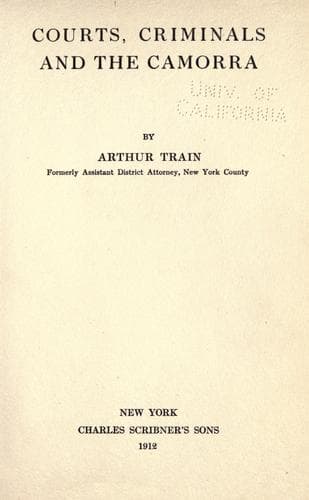
Courts, Criminals and the CamorraTrain, Arthur Cheney
History
Courts, Criminals and the Camorra
Train, Arthur Cheney
Camorra; Criminals -- United States; Justice, Administration of -- United States
One is in doubt whether to believe Abbatemaggio on the one hand or
Rapi on the other, and ends by concluding that it would be utterly
impossible to believe either. Both were acting, both playing to the
gallery. You know Rapi is a crook, and—well you wouldn’t trust
Abbatemaggio, either, around the corner. And, after all, it is the word
of the one against that of the other so far as any particular defendant
is concerned. But one fixed impression remains—that of the aplomb,
intelligence, and cleverness of these men, and the danger to a society
in which they and their associates follow crime as a profession. Once
more you study the faces of the well-dressed prisoners in the cage,
of the four alleged assassins of Cuocolo—Morra, Sortino, de Gennaro,
and Cerrato; of Giuseppe Salvi, the murderer of Maria Cutinelli; of
Luigi Fucci, the dummy head of the Camorra; of “Erricone” Alfano, the
wolfish supreme chief and dictator of the society; of Luigi Arena, the
captain of the Neapolitan burglars; of that mediæval rascal, “Father”
Ciro Vitozzi, the most picturesque figure of the lot; of Desiderio,
head of petty blackmailing and tribute-levying industry; of Maria
Stendardo, whose house was a Camorrist hell; and of Rapi, the gambling
“professor” and “Moriarty” of Naples—and you know instinctively that,
whether as an abstract proposition Abbatemaggio conveys an impression
of absolute honesty or not, what he has said is true and that this is
the Camorra—the real Camorra, vile, heartless, treacherous!
Then, if you were asked to give your impressions of the way the
trial was being carried on, you would probably say that, considering
the magnitude of the task involved, the mass of evidence (there are
forty volumes of the preliminary examinations), the great number of
prisoners and the multitude of witnesses, and the latitude allowed
under the Italian law in the matter of taking testimony, the trial
was being conducted considerably faster than would be probable in
America under like conditions; that the methods followed are admirably
calculated to ascertain the truth or falsity of the charges; that the
judge presides with extreme fairness, courtesy, and ability; that, all
things considered, there is, as a rule, less confusion or disorder than
would be naturally expected—that, in a word, the Italian government is
making a good job of it, and deserves to be congratulated.
Public-domain text, read in full here on John Shaqi.
Reviews
Reviews
No reviews yet
Be the first to share your thoughts on this work.
Elsewhere in the archive
Join the Discussion
Join the discussion
Sign in to leave a comment or review.
Sign InorCreate an account