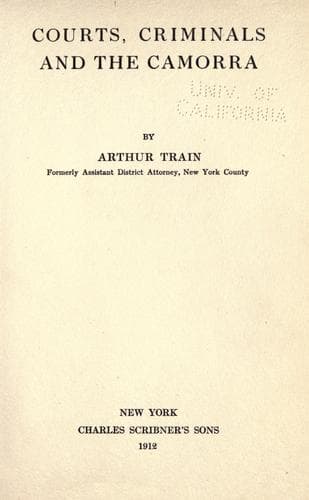
Courts, Criminals and the CamorraTrain, Arthur Cheney
History
Courts, Criminals and the Camorra
Train, Arthur Cheney
Camorra; Criminals -- United States; Justice, Administration of -- United States
At home they have lived in a tumble-down stone hut about fifteen feet
square, half open to the sky (its only saving quality); in one corner
the entire family sleeping in a promiscuous pile on a bed of leaves;
in another a domestic zoo consisting of half a dozen hens, a cock, a
goat, and a donkey. They neither read, think, nor exchange ideas. The
sight of a uniform means to them either a tax-gatherer, a compulsory
enlistment in the army, or an arrest, and at its appearance the man
will run and the wife and children turn into stone. They are stubborn
and distrustful. They are the same as they were a thousand or more
years gone by.
When the writer was acting as an assistant prosecutor in New York
County, a young Italian, barely twenty years of age, was brought to
the bar charged with assault with intent to kill. The complainant was
a withered Sicilian woman who claimed to be his wife. Both spoke an
almost unintelligible dialect. The case on its face was simple enough.
An officer testified that on a Sunday morning in Mulberry Bend Park, at
a distance of about fifty feet from where he was standing, he saw the
defendant, who had been walking peaceably with the complaining witness,
suddenly draw a long and deadly looking knife and proceed to slash her
about the head and arms. It had taken the officer but a moment or two
to seize the defendant from behind and disarm him, but in the meantime
he had inflicted some eleven wounds upon her body. No explanation
had been offered for this terrible assault, and the complainant had
appeared involuntarily before the Grand Jury and afterward had to
be kept in the House of Detention as a hostile witness. The woman,
who appeared to be about fifty years old, was sworn, and on being
questioned stated that she had been married to the defendant in Sicily
three years before. She declined to admit that he had attacked or
harmed her in any way, constantly mumbling: “He is my husband. Do not
punish him!”
The defendant, however, seemed eager to get on the stand and to tell
his story; nor did the introduction of the knife in evidence or the
exhibition of the woman’s wounds embarrass him in the slightest degree.
His manner was that of a man who had only to explain to be entirely
exonerated from blame. He nodded at the jury and the judge, and scowled
at the complainant, who was speedily conducted to a place where no harm
could possibly come to her. When at last he was sworn, he could hardly
restrain himself into coherency.
Public-domain text, read in full here on John Shaqi.
Reviews
Reviews
No reviews yet
Be the first to share your thoughts on this work.
Elsewhere in the archive
Join the Discussion
Join the discussion
Sign in to leave a comment or review.
Sign InorCreate an account