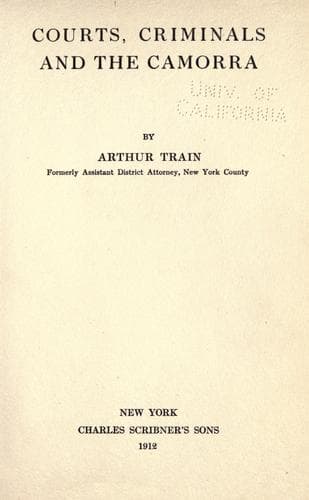
Courts, Criminals and the CamorraTrain, Arthur Cheney
History
Courts, Criminals and the Camorra
Train, Arthur Cheney
Camorra; Criminals -- United States; Justice, Administration of -- United States
So much for the story as an illustration of the mediæval character of
some of our Sicilian immigrants. For the satisfaction of the reader’s
taste for the romantic and picturesque it should be added, however,
that the matter did not end here. The convict, having served several
years, found that the photographer’s assistant was not keeping his part
of the contract, as a result of which the assassin’s wife and children
were suffering for lack of food and clothing. He made repeated but
fruitless attempts to compel the party of the first part to pay up,
and finally, in despair, wrote to the District Attorney of New York
County that he could, if he would, a tale unfold that would harrow up
almost anybody’s soul. Mr. Jerome therefore, on the gamble of getting
something worth while, sent Detective Russo to Auburn to interview
the prisoner. That is how the whole story came to be known. The case
was put in the writer’s hands, and an indictment for the very unusual
crime of attempted murder (there are only one or two such cases on
record in New York State) was speedily found against the photographer’s
assistant. At the trial the lover saw his mistress compelled to turn
State’s evidence against him to save herself. She testified to the
Christmas carols and the cyanide of mercury.
“Did you ever remove this terrible poison from the bolster?” demanded
the defendant’s counsel in a sneering tone.
“No,” answered the woman.
“Have you ever changed the bolster?” he persisted.
“No.”
“Then it’s there yet?”
“I—I think so,” falteringly.
“I demand that this incredible yarn be investigated!” cried the lawyer.
“I ask that the court send for the bolster and cut it open here in the
presence of the jury.”
The writer had no choice but to accede to this request, and the bolster
was hunted down and brought into court. With some anxiety both sides
watched while the lining was slit with a penknife. A few feathers
fluttered to the floor as the fingers of the witness felt inside and
came in contact with _the poison_. The assistant was convicted of
attempted murder on the convict’s testimony, and sentenced to Sing Sing
for twenty-five years. That was the end of the second lesson.
About a month afterward the defendant’s counsel made a motion for a new
trial on the ground that the convict now admitted his testimony to have
been wholly false, and produced an affidavit from the assassin to that
effect. Naturally so startling an allegation demanded investigation.
Yes, insisted the “bravo,” it was all made up, a “camorra”—not a word
of truth in it, and he had invented the whole thing in order to get a
vacation from State prison and a free ride to New York. However, the
court denied the motion. The writer procured a new indictment against
the assassin—this time for perjury—and he was sentenced to another
additional term in prison. What induced this sudden and extraordinary
change of mind on his part can only be surmised.
Public-domain text, read in full here on John Shaqi.
Reviews
Reviews
No reviews yet
Be the first to share your thoughts on this work.
Elsewhere in the archive
Join the Discussion
Join the discussion
Sign in to leave a comment or review.
Sign InorCreate an account