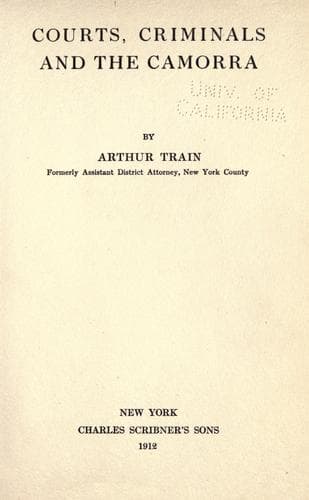
Courts, Criminals and the CamorraTrain, Arthur Cheney
History
Courts, Criminals and the Camorra
Train, Arthur Cheney
Camorra; Criminals -- United States; Justice, Administration of -- United States
It is, in addition, an ultra-successful criminal political machine,
which, under cover of a pseudo-principle, deals in petty crime,
wholesale blackmail, political jobbery, and the sale of elections, and
may fairly be compared to the lowest types of politico-criminal clubs
or societies in New York City. In Palermo it is made up of “gangs” of
toughs and criminals, not unlike the Camorrist gangs of Naples, but
without their organization, and is kept together by personal allegiance
to some leader. Such a leader is almost always under the patronage of
a “boss” in New York or a _padrone_ in Italy, who uses his influence
to protect the members of the gang when in legal difficulties and find
them jobs when out of work and in need of funds. Thus the “boss” can
rely on the gang’s assistance in elections in return for favors at
other times. Such gangs may act in harmony or be in open hostility
or conflict with one another, but all are united as against the
police, and exhibit much the same sort of “Omertà” in Chatham Square
as in Palermo. The difference between the Mafia and Camorra and the
“gangs” of New York City lies in the fact that the latter are so much
less numerous and powerful, and bribery and corruption so much less
prevalent, that they can exert no practical influence in politics
outside the Board of Aldermen, whereas the Italian societies of the
Mala Vita exert an influence everywhere—in the Chamber of Deputies,
the Cabinet, and even closer to the King. In fact, political corruption
has been and still is of a character in Italy luckily unknown in
America—not in the amounts of money paid over (which are large
enough), but in the calm and matter-of-fact attitude adopted toward the
subject in Parliament and elsewhere.
Public-domain text, read in full here on John Shaqi.
Reviews
Reviews
No reviews yet
Be the first to share your thoughts on this work.
Elsewhere in the archive
Join the Discussion
Join the discussion
Sign in to leave a comment or review.
Sign InorCreate an account