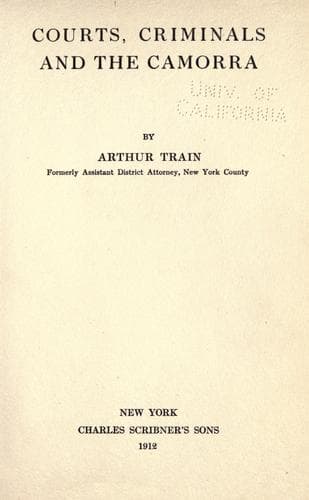
Courts, Criminals and the CamorraTrain, Arthur Cheney
History
Courts, Criminals and the Camorra
Train, Arthur Cheney
Camorra; Criminals -- United States; Justice, Administration of -- United States
Every large city, where people exist under unwholesome conditions,
has some such phenomenon. In Palermo we have the traditional Mafia—a
state of, mind, if you will, ineradicable and all-pervasive. Naples
festers with the Camorra as with a venereal disease, its whole body
politic infected with it, so that its very breath is foul and its
moral eyesight astigmatized. In Paris we find the Apache, abortive
offspring of prostitution and brutality, the twin brother of the
Camorrista. In New York there are the “gangs,” composed of pimps,
thugs, cheap thieves, and hangers-on of criminals, which rise and wane
in power according to the honesty and efficiency of the police, and
who, from time to time, hold much the same relations to police captains
and inspectors as the various gangs of the Neapolitan Camorra do to
commissaries and _delegati_ of the “Public Safety.” Corresponding to
these, we have the “Black Hand” gangs among the Italian population of
our largest cities. Sometimes the two coalesce, so that in the second
generation we occasionally find an Italian, like Paul Kelly, leading a
gang composed of other Italians, Irish-Americans, and “tough guys” of
all nationalities. But the genuine Black Hander (the real Camorrist or
“Mafioso”) works alone or with two or three of his fellow-countrymen.
Curiously enough, there is a society of criminal young men in New York
City who are almost the exact counterpart of the Apaches of Paris. They
are known by the euphonious name of “Waps” or “Jacks.” These are young
Italian-Americans who allow themselves to be supported by one or two
women, almost never of their own race. These pimps affect a peculiar
cut of hair, and dress with half-turned-up velvet collar, not unlike
the old-time Camorrist, and have manners and customs of their own. They
frequent the lowest order of dance-halls, and are easily known by their
picturesque styles of dancing, of which the most popular is yclept the
“Nigger.” They form one variety of the many “gangs” that infest the
city, are as quick to flash a knife as the Apaches, and, as a cult by
themselves, form an interesting sociological study.
Public-domain text, read in full here on John Shaqi.
Reviews
Reviews
No reviews yet
Be the first to share your thoughts on this work.
Elsewhere in the archive
Join the Discussion
Join the discussion
Sign in to leave a comment or review.
Sign InorCreate an account