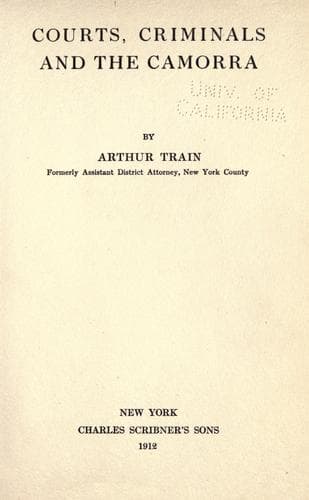
Courts, Criminals and the CamorraTrain, Arthur Cheney
History
Courts, Criminals and the Camorra
Train, Arthur Cheney
Camorra; Criminals -- United States; Justice, Administration of -- United States
The Italian criminal and his American offspring have a sincere
contempt for American criminal law. They are used by experience or
tradition to arbitrary police methods and prosecutions unhampered by
Anglo-Saxon rules of evidence. When the Italian crook is _actually
brought to the bar of justice_ at home, that he will “go” is generally
a foregone conclusion. There need be no complainant in Italy. The
government is the whole thing there. But, in America, if the criminal
can “reach” the complaining witness or “call him off” he has nothing to
worry about. This he knows he can easily do through the terror of the
Camorra. And thus he knows that the chances he takes are comparatively
small, including that of conviction if he is ever tried by a jury of
his American peers, who are loath to find a man guilty whose language
and motives they are unable to understand. All this the young Camorrist
is perfectly aware of and gambles on.
One of the unique phenomena of the Mala Vita in America is the
class of Italians who are known as “men of honor.” These are native
Italians who have been convicted of crime in their own country and
have either made their escape or served their terms. Some of these
may have been counterfeiters at home. They come to America either as
stokers, sailors, stewards, or stowaways, and, while they can not get
passports, it is surprising how lax the authorities are in permitting
their escape. The spirit of the Italian law is willing enough, but its
fleshly enforcement is curiously weak. Those who have money enough
manage to reach France or Holland and come over first or second-class.
The main fact is that they get here—law or no law. Once they arrive
in America, they realize their opportunities and actually start in to
turn over a new leaf. They work hard; they become honest. They may have
been Camorrists or Mafiusi at home, but they are so no longer. They are
“on the level,” and stay so; only—they are “men of honor.” And what is
the meaning of that? Simply that they keep their mouths, eyes, and ears
shut so far as the Mala Vita is concerned. They are not against it.
They might even assist it passively. Many of these erstwhile criminals
pay through the nose for respectability—the Camorrist after his kind,
the Mafius’ after his kind. Sometimes the banker who is paying to a
Camorrist is blackmailed by a Mafius’. He straightway complains to his
own bad man, who goes to the “butter-in” and says in effect: “Here!
What are you doing? Don’t you know So-and-So is under my protection?”
“Oh!” answers the Mafius’. “Is he? Well, if that is so, I’ll leave him
alone—as long as he is paying for protection _by somebody_.”
The reader will observe how the silence of “the man of honor” is not
remotely associated with the Omertà. As a rule, however, the “men of
honor” form a privileged and negatively righteous class, and are let
strictly alone by virtue of their evil past.
Public-domain text, read in full here on John Shaqi.
Reviews
Reviews
No reviews yet
Be the first to share your thoughts on this work.
Elsewhere in the archive
Join the Discussion
Join the discussion
Sign in to leave a comment or review.
Sign InorCreate an account