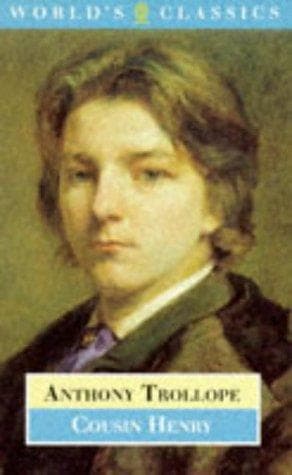
Domestic fiction; Inheritance and succession -- Fiction; Wales -- Fiction
"Nor know where it lies hidden?" Ghastly pale he became,--livid,
almost blue by degrees. Though he was fully determined to give up the
will, he could not yield to the pressure now put upon him. Nor could
he withstand it. The question was as terrible to him as though he had
entertained no idea of abandoning the property. To acknowledge that
he knew all along where it was hidden would be to confess his guilt
and to give himself up to the tormentors of the law.
"Nor know where it lies hidden?" repeated Mr Apjohn, in a low voice.
"Go out of the room, Ricketts," he said. "Nor know where it lies
hidden?" he asked a third time when the clerk had closed the door
behind him.
"I know nothing about it," gasped the poor man.
"You have nothing beyond that to say to me?"
"Nothing."
"You would rather that it should be left to Mr Cheekey? If there be
anything further that you can say, I should be more tender with you
than he."
"Nothing."
"And here, in this room, there is no public to gaze upon you."
"Nothing," he gasped again.
"Very well. So be it. Ricketts, see if the fly be there for Mr
Jones." A few minutes afterwards his confidential clerk was alone
with him in the room.
"I have learned so much, Ricketts," said he. "The will is still in
existence. I am sure of that. And he knows its whereabouts. We shall
have Miss Brodrick there before Christmas yet."
CHAPTER XIX
Mr Apjohn Sends for Assistance
The last words in the last chapter were spoken by Mr Apjohn to his
confidential clerk in a tone of triumph. He had picked up something
further, and, conscious that he had done so by his own ingenuity,
was for a moment triumphant. But when he came to think over it all
alone,--and he spent many hours just at present in thinking of this
matter,--he was less inclined to be self-satisfied. He felt that a
great responsibility rested with him, and that this weighed upon
him peculiarly at the present moment. He was quite sure not only
that a later will had been made, but that it was in existence. It
was concealed somewhere, and Cousin Henry knew the secret of its
hiding-place. It had existed, at any rate, that morning; but now came
the terrible question whether the man, driven to his last gasp in his
misery, would not destroy it. Not only had Mr Apjohn discovered the
secret, but he was well aware that Cousin Henry was conscious that he
had done so, and yet not a word had been spoken between them which,
should the will now be destroyed, could be taken as evidence that it
had ever existed. Let the paper be once burnt, and Cousin Henry would
be safe in possession of the property. Mr Cheekey might torment his
victim, but certainly would not extract from him a confession such as
that. The hiding of the will, the very place in which it was hidden,
might possibly be extracted. It was conceivable that ingenuity on
one side and abject terror on the other might lead a poor wretch to
betray the secret; but a man who has committed a felony will hardly
Public-domain text, read in full here on John Shaqi.
Reviews
Reviews
No reviews yet
Be the first to share your thoughts on this work.
Elsewhere in the archive
Join the Discussion
Join the discussion
Sign in to leave a comment or review.
Sign InorCreate an account