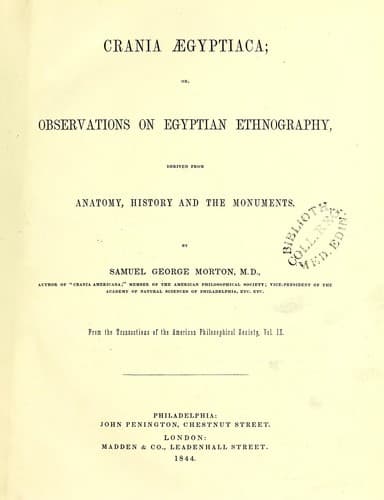
Crania Ægyptiaca: Or, Observations on Egyptian Ethnography Derived from Anatomy, History and the MonumentsMorton, Samuel George
History
Crania Ægyptiaca: Or, Observations on Egyptian Ethnography Derived from Anatomy, History and the Monuments
Morton, Samuel George
Craniology -- Egypt; Ethnology -- Egypt
Dr. Oudney, who saw them in great number, describes them in nearly
similar terms, but assures us that under favourable circumstances
their good, sound sense, would soon render them “a shining people.” It
is curious, also, to note the following remark of the same intelligent
traveller: “On almost every stone, in places they frequent, the
Tuarick characters are hewn out. It matters not whether the letters
are written from right to left, or _vice versa_, or horizontally,” a
singular accordance with the graphical system of the ancient
Egyptians.[51] It would therefore appear, that these roving
descendants of the Libyan race possess, even now, some vestiges of
that innate love of sculpture which was cultivated on so grand a scale
by the temple-builders of the Nile.
Yet farther south are the darker Berber tribes called Siwahs or
Shouas, who are said by Major Denham to have “free open countenances,
with aquiline noses and large eyes; their complexion is a light copper
colour. They possess great cunning with their courage, and resemble,
in appearance, some of the best favoured Gypsies in England.” Dark as
they are, he remarks that “in comparison with the Negresses they are
almost white.” They are vastly numerous throughout all Soudan, Houssa
and Bornou, and the Sultan of the latter country has no less than
15,000 of them in his army.[52]
In other instances, although they are few in comparison, the Berbers
assimilate more to the Negro on account of the proximity of the two
races; a remark which is especially made by Dr. Oudney in reference to
the Tuaricks of Mourzouk, who have black and curling hair, but which,
“from a Negro mixture, is inclined to be crispy.”[53]
Here then are the various gradations of the Caucasian type which
appear to have marked the ancient Egyptians, together with a degree of
that intermixture of the Negro race which is revealed in the
catacombs, and perpetuated in the modern Coptic population.
In connexion with this subject, it is curious to remark that the
Guanches of the Canary Islands were a branch of the Berber or Libyan
stock; and the singular perfection to which they brought the art of
embalming, long since led to the supposition that they might have been
affiliated with the Egyptians. The only Berber skull in my possession
is of this insular branch of that race, and like the one figured by
Professor Blumenbach, bears a striking resemblance to the Egyptian
conformation.[54]
THE ETHIOPIANS.—Every one who has paid the slightest attention to the
present inquiry, is aware of the entire vagueness of the name
_Ethiopia_ (Cush) as used by the ancients; which, like _India_ in
modern times, was applied to countries very remote from each other,
and whose inhabitants were remarkably dissimilar. Thus
Austral-Egyptians, Hindoos, Arabs, and Negroes, and even the Egyptians
themselves, have each in turn been embraced in this designation.
Public-domain text, read in full here on John Shaqi.
Reviews
Reviews
No reviews yet
Be the first to share your thoughts on this work.
Join the Discussion
Join the discussion
Sign in to leave a comment or review.
Sign InorCreate an account