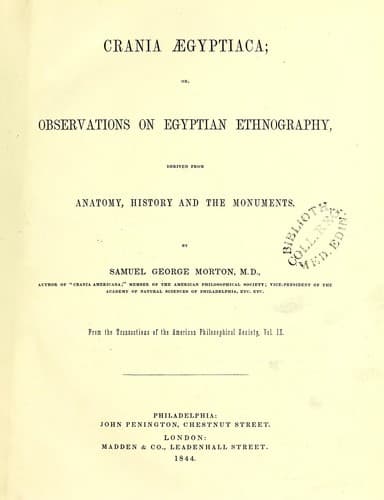
Crania Ægyptiaca: Or, Observations on Egyptian Ethnography Derived from Anatomy, History and the MonumentsMorton, Samuel George
History
Crania Ægyptiaca: Or, Observations on Egyptian Ethnography Derived from Anatomy, History and the Monuments
Morton, Samuel George
Craniology -- Egypt; Ethnology -- Egypt
Leaving this important and difficult philological inquiry to the abler
hands of Mr. Hodgson, (for it involves some points on which I am not
qualified to judge, and therefore offer no opinion,) we may merely
remark, that the Berber theory is farther countenanced by various
mythological considerations, among the most remarkable of which is the
supposed Libyan origin of several Egyptian divinities.
Particular communities of the Libyans are familiar in history by the
names of Mauritanians, Numidians and Getuli. Respecting the physical
characteristics of these people, history is nearly silent; yet there
is sufficient evidence to prove, that they possessed those features
which are now called Caucasian, independently of any modifications
that may have resulted from their long intercourse with Phenician
colonies, and the Romans, Arabs and Vandals in later periods of time.
The Libyans were a nomadic and warlike people; they were habitually
employed in the Carthagenian armies, and in the earlier ages contended
with the Egyptians themselves; for we learn from a passage in Manetho,
(CORY, Frag. p. 100,) that in the remote age of Necherophes, of the
third dynasty, the Libyans revolted from the Egyptians, but were soon
again subdued. The monuments record similar triumphs in the reigns of
Osortasen 1st., Thotmes 1st., Rameses the 3d, and indeed in almost
every dynasty down to the Ptolemaic epoch, when Libya continued to be
an Egyptian province. In fact, the Libyans hung upon the skirts of
Egypt as the Goths did upon Rome; and until the researches of the
hierologists identified the Hykshos or shepherd kings with an Asiatic
people, there was strong presumptive evidence that these ruthless
invaders were, at least in part, no other than the Libyans
themselves.[49]
The Libyans are represented in our day by the various and motley
Berber tribes, who under the names of Tuaricks, Kabyles and Siwahs,
inhabit both north and south of Mt. Atlas; and in their physical
characters combine the Caucasian physiognomy with various shades of
complexion, from a fair skin to a dark and tawny hue.
“The Kabyles,” says Mr. Shaler, “are a white people, of middle
stature, muscular, athletic and active, but never corpulent; and are
of lively, social manners and of ingenious dispositions. Many of them
are of light complexions, with hair approaching to flaxen, resembling
rather the peasants of the south of Europe than the inhabitants of
Africa.”[50] Then come the darker Tuaricks, men of fine mould and
adventurous spirit, but nomadic, unfeeling and vindictive.
Public-domain text, read in full here on John Shaqi.
Reviews
Reviews
No reviews yet
Be the first to share your thoughts on this work.
Join the Discussion
Join the discussion
Sign in to leave a comment or review.
Sign InorCreate an account