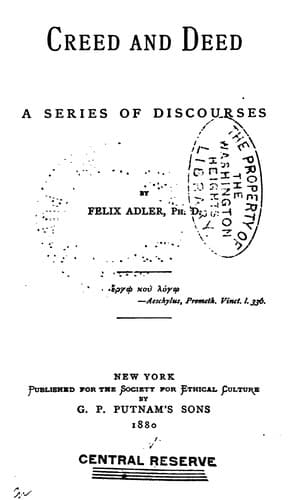
Creed and Deed: A Series of DiscoursesAdler, Felix
Religion
Creed and Deed: A Series of Discourses
Adler, Felix
Ethical culture movement; Ethics; Religion
That the editor of the Pentateuch had admitted into his volume several
accounts touching the main facts of early Hebrew history; that these
accounts are often mutually at variance; that minute analysis and
careful comparison alone can lead to an approximately true estimate
of their comparative value; and, lastly, that the transmission of
historical information had in no wise been the object of the Hebrew
writers. The history of their people served, it is true, to illustrate
certain of their doctrines concerning the divine government of the
world, and especially the peculiar relations of the Deity to the chosen
race; but it was employed much in the sense of a moral tale, being
designed, not to convey facts, but to enforce lessons. Had the
acceptance of any particular scheme of Hebrew history been deemed
essential to the integrity of religious belief, the Bible, they argued,
would certainly not have included discrepant accounts of that history in
its pages. In the light of this new insight, it seemed advisable to draw
a distinction between the biblical narrative proper and the doctrines
which it was designed to illustrate. The latter belong to the province
of faith, and their treatment may be left to the expounders of faith.
The former is a department of general history, and in dealing with it
we are at liberty to apply the same canons of criticism that obtain in
every other department, without fearing to trespass upon sacred ground.
It is our purpose in the following pages to present some of the
more interesting results that have been reached in the study of the
Pentateuch, so far as they illustrate the evolution of religious ideas
among the Hebrews. We shall begin by summarizing a few instances of
discrepant testimony to introduce our subject, and, in particular, to
show how little the ordinary purposes of history have been considered
in the composition of the biblical writings; how little the bare
transmission of facts was an object with the sacred authors.*
Public-domain text, read in full here on John Shaqi.
Reviews
Reviews
No reviews yet
Be the first to share your thoughts on this work.
Elsewhere in the archive
Join the Discussion
Join the discussion
Sign in to leave a comment or review.
Sign InorCreate an account