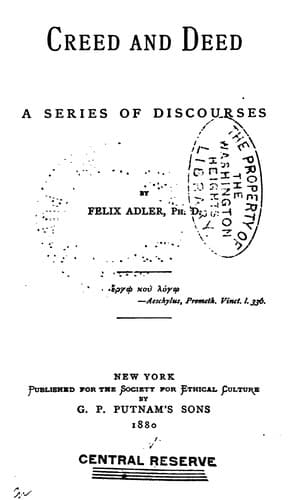
Creed and Deed: A Series of DiscoursesAdler, Felix
Religion
Creed and Deed: A Series of Discourses
Adler, Felix
Ethical culture movement; Ethics; Religion
Gen. xvi., Hagar is driven from her home by the jealousy of her
mistress; escapes into the desert; beholds a vision of God at a well in
a wilderness. Gen. xxi., the flight of Hagar is related a second time.
The general scheme of the narrative is the same as above; but there
are important divergencies of detail. As narrated in chapter xvi., the
escape took place immediately before the birth of Ishmael. Fifteen years
elapsed,** and Ishmael, now approaching the years of maturity, is once
more driven forth from the house of Abraham. But, to our surprise, in
chapter xxi. the lad is described as a mere infant; he is carried on
his mother's shoulders, and laid away, like a helpless babe, under some
bushes by the wayside. It appears that we have before us two accounts
touching the same event, agreeing in the main incidents of the escape,
but showing a disagreement of fifteen years as to the date of its
occurrence. The narratives are distinguished as above by the employment
of different names of the Deity: Jehovah in the one instance, Elohim in
the other.
* For an account of the close analogy between the biblical
narration and the Persian story of Meshja and Meshjane,
their temptation and fall, vide ibid. p. 40. It is of
special importance to note that reference to the account of
Genesis ii. is made only in the later literature of the
Hebrews, ibid., p. 42.
** Gen. xvii. 25. In quoting from the Old Testament, we
follow the order of the Hebrew text.
Gen. xxxii., Jacob at the fords of Jabbok, after wrestling during the
night with a divine being, receives the name of Israel. Gen. xxxv.,
without reference to the previous account, the name Israel is conferred
upon Jacob at a different place and under different circumstances.
Gen. xlix., the dispersion of the Levites among the tribes is
characterized as a punishment and a curse. They are to be forever
homeless and fugitive. Deuteronomy xxxiii. and elsewhere, it is
described as a blessing. The Levites have been scattered as good seed
over the land. They are apostles, commissioned to propagate Jehovah's
law.
Passing on to the second book of the Pentateuch, we pause before the
account of the Revelation on Mount Sinai, beyond a doubt the most
important event of Israel's ancient history. Exodus xxiv. 2, Moses alone
is to approach the divine presence. Exod. xix. 24, Aaron is to accompany
him. Exod. xxiv. 13, Aaron is to remain below and Joshua is to go in
his stead. Again, Exod. xxxiii. 20, instant death will overtake him
who beholds God. Exod. xxiv. 9-11, Moses, Aaron, two of his sons, and
seventy elders of Israel "ascended, and they saw the God of Israel....
Also, they saw God, and did eat and drink." Once more, Exod. xxiv. 4-7,
Moses himself writes down the words of revelation in a book of covenant.
Exod. xxiv. 12, not Moses but God writes them; and, elsewhere, "Two
tables of stone inscribed by the finger of God."
Public-domain text, read in full here on John Shaqi.
Reviews
Reviews
No reviews yet
Be the first to share your thoughts on this work.
Elsewhere in the archive
Join the Discussion
Join the discussion
Sign in to leave a comment or review.
Sign InorCreate an account