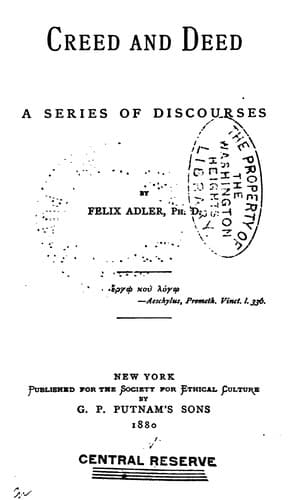
Creed and Deed: A Series of DiscoursesAdler, Felix
Religion
Creed and Deed: A Series of Discourses
Adler, Felix
Ethical culture movement; Ethics; Religion
It was a dismal and sorrowful age. The bonds of social order were
loosened; the current conceptions of the Deity and the rites of his
worship were gross and often degrading. Mutual jealousies kindled the
firebrand of war among the contending clans. Almost the whole tribe of
Benjamin was extirpated. Abimelech slew seventy princes upon one stone.
Lust and treachery ran riot. A wilder deed has never been chronicled in
the annals of mankind than that related in chapter xix. of Judges,
nor ever has a terrible deed been more terribly avenged. Now, looking
backward, we ask, Is it to be believed that in the fourteenth century B.
C. not only the leader of Israel, but also their elders, their priests,
nay, large numbers of the very populace, shared in the most exalted,
the most spiritual conceptions of God, and nourished the most refined
sentiments in regard to human relationships, while immediately
thereupon, and centuries thereafter, violence and bloodshed, and
idolatry, do not cease from the records? It has been argued, indeed,
that the worship of idols was but a _relapse_ from the purity of a
preceding age; and that, though the tradition of the Mosaic time may
have been lost in the succeeding period among the people at large, it
was still preserved in the circle of a select few, the judges, King
David, and others. These, it is believed, continued to remain faithful
disciples of the great lawgiver. But these very men, the judges--King
David himself--all fall immeasurably below the standard that is set up
in the Pentateuch. If they were esteemed the true representatives of
the national religion in their day, if the very points in which they
transgressed the provisions of the Mosaic code are distinguished by
the approval of God and man, we are forced to conclude that that
standard--by which they stand condemned--did not yet exist; that, in
the days of David, the laws of Moses, as we now have them; were as yet
unwritten and unknown. Let us illustrate this important point by a few
examples taken from the records. Gideon no sooner returns from victory
than he makes a golden idol and sets it up for worship. Jephthah
slays his daughter as an offering of thanksgiving to Jehovah. In
the Pentateuch the adoration of images is branded as the gravest of
offences. David keeps household gods in his own home (Sam. xix). In the
Pentateuch, on its opening page, God is proclaimed as a pure spirit,
maker of heaven and earth. In the eyes of David (1 Sam, xxvi. 19), the
sway of Jehovah does not extend beyond the borders of Palestine.* In the
Pentateuch the ark of the covenant is described as the treasury of all
that is brightest and best in the worship of the one God. None but
the consecrated priest dare approach it, and even he only under
circumstances calculated to inspire peculiar veneration and awe. In 2
Sam. vi., David abandons the ark to the keeping of a heathen Philistine.
In an early age of culture, when fear and terror in the presence of
Public-domain text, read in full here on John Shaqi.
Reviews
Reviews
No reviews yet
Be the first to share your thoughts on this work.
Elsewhere in the archive
Join the Discussion
Join the discussion
Sign in to leave a comment or review.
Sign InorCreate an account