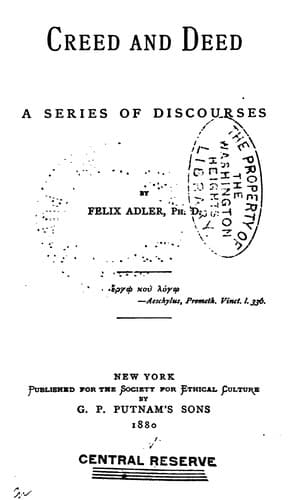
Creed and Deed: A Series of DiscoursesAdler, Felix
Religion
Creed and Deed: A Series of Discourses
Adler, Felix
Ethical culture movement; Ethics; Religion
But in the meantime a new force had entered the current of Hebrew
history. The conviction that one God, and he an all-just, almighty
being, ruled the destinies of Israel, began to take root. In the eighth
century B. C. authentic records prove that monotheism, as a form of
religious belief, obtained, at least among the more illustrious members
of the prophetic order. We have elsewhere attempted to trace the causes
which led to the rise of monotheism at this particular epoch, and can do
no more than briefly allude to them here.
When the mountaineers of Southern Palestine, after centuries of
protracted struggles, had secured the safe possession of individual
homes, the endearments of domestic life were invested with a sanctity in
their eyes never before known. The attachment of the Hebrew toward his
offspring was intensified; his devotion to the wife of his bosom became
purer and more enduring. Now, the prevailing forms of Semitic religion
outraged these feelings at every point. The gods of the surrounding
nations were gods of pleasure and of pain; and in their worship the
stern practices of fanatic asceticism alternated with the wildest orgies
of sensual enjoyment. The worship of Baal Moloch demanded the sacrifice
of children; that of the lascivious Baaltis insulted the modesty of
woman. The nobler spirits among the Hebrews rebelled against both these
demands. And, as the latter were put forth in the name of the dominant
religion, the inevitable conclusion followed that that religion itself
must be radically wrong. The spirit of opposition thus awakened was
aroused into powerful activity when, in the days of Ahab, the queen,
supported by an influential priesthood, determined to introduce the
forms of Phoenician religion in Israel by measures of force. The
royal edicts were resisted, but for a while the rule of the stronger
prevailed. The leaders of the opposition were compelled to flee, and,
avoiding the habitations of men, to take refuge in wild and solitary
places. Thus the rupture was widened into schism, and persecution
inflamed the zeal and kindled the energies of that new order of men of
whom Elijah is the well-known type.
Public-domain text, read in full here on John Shaqi.
Reviews
Reviews
No reviews yet
Be the first to share your thoughts on this work.
Elsewhere in the archive
Join the Discussion
Join the discussion
Sign in to leave a comment or review.
Sign InorCreate an account