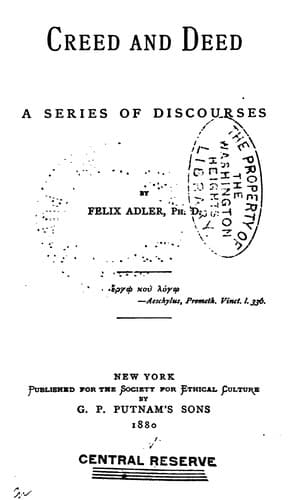
Creed and Deed: A Series of DiscoursesAdler, Felix
Religion
Creed and Deed: A Series of Discourses
Adler, Felix
Ethical culture movement; Ethics; Religion
The sacredness of the family tie is the condition both of the physical
soundness and the moral vigor of nations. The family is the miniature
commonwealth, upon whose integrity the safety of the larger commonwealth
depends. It is the seedplot of all morality. In the child's intercourse
with its parents the sentiment of reverence is instilled--the essence
of all piety, all idealism; also the habit of obedience to rightful
authority, which forms so invaluable a feature in the character of the
loyal citizen. In the companionship of brothers deference to the rights
of equals is practically inculcated, without which no community could
exist. The relations between brother and sister give birth to the
sentiment of chivalry,--regard for the rights of the weaker,--and this
forms the basis of magnanimity, and every generous and tender quality
that graces humanity. Reverence for superiors, respect for equals,
regard for inferiors,--these form the supreme trinity of the virtues.
Whatever is great and good in the institutions and usages of mankind
is an application of sentiments that have drawn their first nourishment
from the soil of the family. The family is the school of duties. But
it has this distinguishing excellency, that among those who are linked
together by the strong ties of affection duty is founded on love. On
this account it becomes typical of the perfect morality in all the
relations of life, and we express the noblest longings of the human
heart when we speak of a time to come in which all mankind will be
united "as one family." Now the preeminence of the Jews in point of
domestic purity will hardly be disputed. "In this respect they stand
out like a bold promontory in the history of the past, singular and
unapproached," said the philosopher Trendelenburg.* According to the
provisions of the Mosaic Code, the crime of adultery is punished with
death. The most minute directions are given touching the dress of the
priests and the common people, in order to check the pruriency of fancy.
The scale of forbidden marriages is widely extended with the same end in
view.
* Vide the essay on the Origin of Monotheism in Jahrbuch des
Vereins fur Wissenschaftliche Padagogik, Vol IX. 1877, by
the author of this article.
Public-domain text, read in full here on John Shaqi.
Reviews
Reviews
No reviews yet
Be the first to share your thoughts on this work.
Elsewhere in the archive
Join the Discussion
Join the discussion
Sign in to leave a comment or review.
Sign InorCreate an account