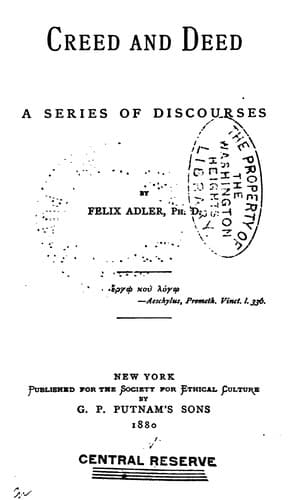
Creed and Deed: A Series of DiscoursesAdler, Felix
Religion
Creed and Deed: A Series of Discourses
Adler, Felix
Ethical culture movement; Ethics; Religion
And yet these distinctions, senseless in
themselves, were full of ominous meaning to those who felt their
burden. Young men eager for advancement in life found their religion
an insuperable obstacle in their way. The professions, the army, the
offices of the government, were closed against them. On the threshold of
every higher career they were rudely repulsed, unless they embraced
the base alternative of changing their creed to satisfy their ambition.
Under these circumstances that fidelity to the faith of the fathers
which had so long marked the conduct of the Jews began seriously
to waver, and in many instances gave way. Not, indeed, that the new
converts became true and loyal Christians. On the contrary, they
considered the rite of baptism a mere hollow form, and left it to the
state, which had insisted upon their conformance, to justify the deep
disgrace that was thus brought upon the Christian sacraments. Moreover,
a certain laxity in the interpretation of dogma had at this time
become widely prevalent, which greatly assisted them in setting their
conscience at ease. Rationalism had stripped the positive religions
of much of their substance and individuality. To none of them was an
absolute value allowed. They were regarded as forms in which a principle
higher than all forms had found an imperfect and temporary expression.
Even the influence of Schleiermacher tended rather to obliterate than to
define the outlines of the contending creeds. Schleiermacher, the author
of a Protestant revival in Germany, spoke the language of Pantheism,
and his opinions are deeply suffused with the spirit of Pantheistic
teachings. He defines religion to be the sense of dependence on the
Infinite, the Universal. To the fact that different men in different
ages have been variously affected by the conception of the Infinite
he ascribes the origin of the different creeds. Theological dogmas,
according to him, cannot claim to be true in the sense of scientific or
philosophical propositions. They approach the truth only in so far as
they typically express certain emotional processes of our soul, and
those dogmas are nearest the truth which typify emotions of the most
noble and exalted character. Allowing Christianity to be what its
learned expounders had defined it, intelligent Jews could hardly find
it difficult to assume the Christian name. It is estimated that in the
course of three decades full one half of the Jewish community of Berlin
were nominally Christianized.
Public-domain text, read in full here on John Shaqi.
Reviews
Reviews
No reviews yet
Be the first to share your thoughts on this work.
Elsewhere in the archive
Join the Discussion
Join the discussion
Sign in to leave a comment or review.
Sign InorCreate an account