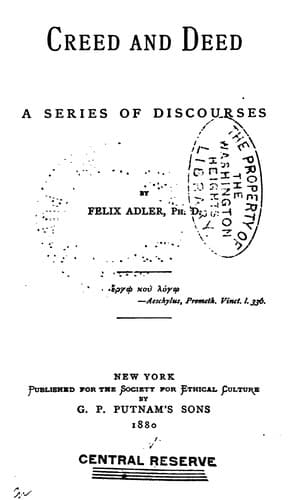
Creed and Deed: A Series of DiscoursesAdler, Felix
Religion
Creed and Deed: A Series of Discourses
Adler, Felix
Ethical culture movement; Ethics; Religion
The progress of the Reform movement was thus of a character to awaken
distrust and fierce contention at every step. The conservative party
were enraged at what they considered unwarrantable encroachments upon
the traditions of an immemorial past. The radicals were dissatisfied
with the lack of substance and vitality in the teachings of the
Reformers, the shallow moralizing tone of their preachers, the
superficial views of Judaism which they scattered among the multitude.
It may indeed be asked how could better things have been expected at
that time. The great facts of Jewish history were not yet clearly known,
the philosophy of Judaism was proportionately vague and uncertain. No
Jewish author had ever undertaken to write out the annals of his people;
chaotic confusion reigned in their chronicles. To know what Judaism
might be it seemed necessary to ascertain in the first instance what it
had been; the past would prove the index of the future. Untoward events
that happened at this period gave a powerful impulse to historical
research, and led to fruitful investigations in the domain of Judaism.
"HEP-HEP."
The great battles of 1813 and 1815, in which the German people regained
their independence, effected a marvellous change in the spirits and
sentiments of the nation.
Accustomed for a long time to endure in silence the insults and
arrogance of a foreign despot, they had learned to despair of
themselves; a deadly lethargy held their energies in bondage and in
the fairy visions of poetry and the daring dreams of metaphysical
speculation they sought consolation for the pains and burdens of
reality. The victories of Leipsic and Waterloo completely altered the
tone of their feelings. It is a not uncommon fact that individuals
usually the reverse of self-asserting exhibit, on occasions, an
overweening self-consciousness, which is all the more pointed and
aggressive because of their secret and habitual self-distrust. We note
with curious interest the recurrence of the same obnoxious trait in the
life of a great nation. The novel sense of power intoxicated them, the
German mind for the moment lost its poise; Romanticism flourished, the
violence of the Middle Ages was mistaken for manhood, and held up to the
emulation of the present generation. Whatever was German was therefore
esteemed good; whatever was foreign was therefore despised, or at best
ignored.
Public-domain text, read in full here on John Shaqi.
Reviews
Reviews
No reviews yet
Be the first to share your thoughts on this work.
Elsewhere in the archive
Join the Discussion
Join the discussion
Sign in to leave a comment or review.
Sign InorCreate an account