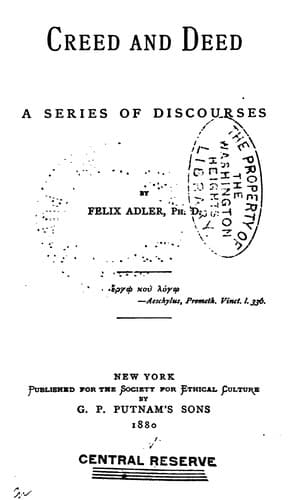
Creed and Deed: A Series of DiscoursesAdler, Felix
Religion
Creed and Deed: A Series of Discourses
Adler, Felix
Ethical culture movement; Ethics; Religion
Around the standard which Geiger had unfurled a body of earnest men
soon collected, who agreed with him in the main in desiring to reconcile
science and life (_Wissenschaft und Leben_). They were mostly young men,
fresh from the universities, profoundly versed in Hebrew and rabbinic
lore, zealous lovers of their religion, equipped with the elements of
ancient and modern culture, and anxious to harmonize the conflicting
claims of both in their private lives and public station. Many of them
underwent severe privations for their convictions' sake. They were
distrusted by the various governments, without whose sanction no Jewish
clergyman could enter upon his functions, and were made to feel, in
common with other Liberals, the displeasure which their measures,
moderate though they were, had provoked in high quarters. They were
subjected to numberless petty annoyances, and even downright force
was employed to check their growing popularity. With the accession of
Frederick William IV., the Ultramontanes and the party of retrogression
in the Protestant Church completely gained the ascendant. Covered by
the shield of royal favor they offered the most audacious insults to the
conscience and common-sense of the people, the right of free speech was
impaired, the press was shackled, while the most abject superstitions
were openly encouraged. The holy coat of Jesus, exhibited at the
cathedral of Treves, attracted hundreds of thousands of pilgrims, and
the fame of the miraculous cures it had effected was diligently spread.
But the very violence of the extremists provoked a determined opposition
among the intelligent classes. National unity and individual liberty
were loudly demanded, a German Catholic party was formed with the avowed
object of reorganizing Catholicism on the basis of the modern State.
Free religious congregations began to crop up here and there, which,
though feeble as yet in their organization, were properly regarded as
significant of the spirit of the times. On the waves of the turning tide
the young Rabbis were carried along. They were ardent patriots;
they too, were eager to see their religion wedded to the progressive
tendencies of the age. The sympathies of the most enlightened of their
brethren were cheerfully extended to them, and high hopes were founded
on their success.
In 1844 they were sufficiently strong to meet in convention. Disclaiming
the functions of a religious synod, they assumed the character of a
scientific body, assembled to promote the objects of truth in their
special department. The discussions were indeed intended to secure
harmony of sentiment and action, but the resolutions adopted were
binding neither upon the members themselves nor upon the congregations
they represented. Three times these conventions were repeated at
Brunswick, Frankfort, and Breslau.
Public-domain text, read in full here on John Shaqi.
Reviews
Reviews
No reviews yet
Be the first to share your thoughts on this work.
Elsewhere in the archive
Join the Discussion
Join the discussion
Sign in to leave a comment or review.
Sign InorCreate an account