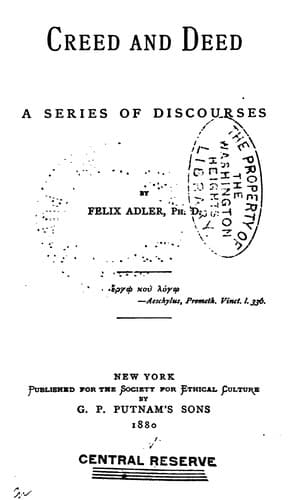
Creed and Deed: A Series of DiscoursesAdler, Felix
Religion
Creed and Deed: A Series of Discourses
Adler, Felix
Ethical culture movement; Ethics; Religion
Ever since the appearance of Geiger's "Scientific Journal," Jewish
philology and Jewish theology have been inseparably connected. To
attempt a detailed account of the latter would involve the necessity
of frequent reference to the former, an attempt in which we can hardly
assume the reader's interest would bear us out. Unwilling to test his
patience by such a course, we shall content ourselves with stating
the main principles of Reformed Judaism, and briefly indicating the
successive steps by which it advanced to its present positions.
The one great fact which the Science of Judaism has indisputably
established was the fact of evolution in the sphere of the Jewish
religion. Each generation had legislated for itself. The authorities of
the Middle Ages had introduced changes in the ritual; the Talmud itself,
that corner-stone of orthodoxy, was a stupendous innovation on the
simplicity of Bible religion.* Applying the theory of evolution to their
own case, the modern Rabbis assumed on their part the right to institute
whatever changes the exigencies of the age had rendered imperative.
* The theory of an Oral Law, delivered to Moses on Sinai and
handed down from generation to generation, until it was
finally embodied in the ordinance of the Talmudical
academies, is a palpable fiction, invented by the Talmudists
in order to lend to their own decisions the sanction of
Divine authorship.
The very fact of change, it is true, presupposes the existence of a
substratum that remains unchangeable. What that substratum in the case
of Judaism is claimed to be, we shall presently discover. The measures
of the Reformers were in the main dictated by the sentiment of
patriotism and the desire to remove the barriers that interposed between
them and their fellow-men. They would cease to be a "state within-the
state," cease to separate themselves from the fellowship of the
Gentiles. Hence the leading proposition upon which Reformed Judaism is
founded. _The Jewish people have ceased to be a national unit, and will
exist hereafter as a confederation of religious societies._
Public-domain text, read in full here on John Shaqi.
Reviews
Reviews
No reviews yet
Be the first to share your thoughts on this work.
Elsewhere in the archive
Join the Discussion
Join the discussion
Sign in to leave a comment or review.
Sign InorCreate an account