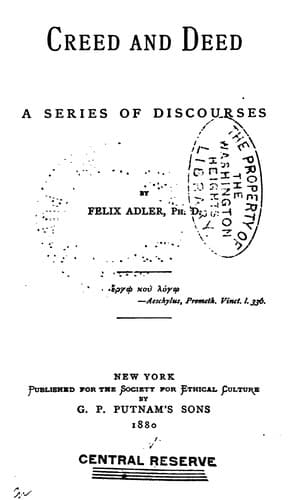
Creed and Deed: A Series of DiscoursesAdler, Felix
Religion
Creed and Deed: A Series of Discourses
Adler, Felix
Ethical culture movement; Ethics; Religion
The present condition of liberal Judaism is strongly akin to that of
liberal Christianity. The old is dead, the new has not been born. It
is hardly safe to predict what possible developments the future may yet
have in store. As regards the Jews, however, it is right to add that
such changes as have taken place in the constitution of their religion
have not brought them in any sense nearer to Christianity. On the
contrary, since the belief in a personal Messiah has been dropped, the
hope of their conversion has become more vague and visionary than
ever. Those whom the worship of the synagogue and the temple no longer
attracts either become wholly sceptical and indifferent, or, as is often
the case, transfer their allegiance to the new humanitarian doctrine
which is fast assuming the character of a religion in the ardor it
inspires and the strong spiritual union it cements. For the great body
of the Jews, however, the central doctrine of Judaism remains unshaken,
and doubtless, so long as Christianity exists, Judaism as a distinct
creed will coexist with it. The modern Jews, like their ancestors,
believe that their mission is not yet ended, and they await with
patience the rising of some new man of genius amongst them, who will
combine the qualities of the popular leader with.'the attributes of
the scholar, and will give body and form to the ideas elaborated by the
Reformers. As a religious society they desire to remain distinct. But
as citizens, they are eager to remove whatever distinctions still hamper
their intercourse with their neighbors of other creeds. Never has the
desire to return to Palestine and retrieve their lost nationality been
more foreign to their sentiments than at the present day, though recent
speculations have misled many to believe otherwise. They know they can
no more return thither. They would not if they could. They love the land
of their birth; they wish to join their labors with those of others in
promoting the progress of the entire human race. They have ceased to
regret the past, and desire nothing more earnestly than to live in the
present and for the future.
THE END.
Public-domain text, read in full here on John Shaqi.
Reviews
Reviews
No reviews yet
Be the first to share your thoughts on this work.
Elsewhere in the archive
Join the Discussion
Join the discussion
Sign in to leave a comment or review.
Sign InorCreate an account